Fable vs Opus comes down to the job. Opus 5.5 is the model for most work, and Fable 5.2 is for long, hard agent jobs where it leads Opus 5.5 on most of Anthropic’s benchmarks. Anthropic released Fable 5.2 on November 9, 2026, and its launch post says: “For most coding and knowledge tasks, we recommend that users start with Claude Opus 5.5, our strongest daily driver.”
We ran three same-task tests on both models that day: a sales dashboard, a bug fix and a keyword research job. Both reached the same answers each time. Fable 5.2 cost 1.7 to 6.5 times as much, and built a working page in both dashboard runs where Opus 5.5 left one blank.
On a Claude plan the gap is in your limits as well as your bill. Fable uses the weekly limit faster than Opus, and only up to half of it on Max and Ultra. We make Context Board, which keeps that week, and Fable’s share of it, on a dashboard. It gets one section near the end.
- Default to Opus 5.5: Anthropic calls it “our strongest daily driver.” It costs half as much per token as Fable 5.2.
- Reach for Fable 5.2 for work that runs for hours, spans a whole codebase, or keeps failing on Opus 5.5 at high effort.
- Our tests: the same answers on all three jobs. Fable 5.2 cost 1.7 to 6.5 times as much, and checked its work more closely.
- Your plan: Opus 5.5 sits inside every paid plan’s limits. Fable takes at most half of a Max or Ultra week and runs on usage credits on Pro.
- Watch the week: Fable drains it faster. Context Board shows what is left, with an alert before it runs out.
Fable 5.2 vs Opus 5.5 at a glance
Anthropic’s model overview describes Fable 5.2 as built for “demanding reasoning and long-horizon agentic work” and Opus 5.5 for “long-running agentic coding and knowledge work.” Prices are from its pricing page, read on November 9, 2026.
| Fable 5.2 | Opus 5.5 | |
|---|---|---|
| Released | November 9, 2026 | September 22, 2026 |
| Input and output, per million tokens | $8 and $40 | $4 and $20 |
| Cache hit, per million | $0.20 | $0.20 |
| Fast mode, per million | $16 and $80 | $8 and $40 |
| Context and longest reply | 1M and 128K tokens | 1M and 128K tokens |
| On Pro | Usage credits, except launch week | Inside the plan’s limits |
| On Max and Ultra | Up to 50% of the weekly limit, used faster | Inside the plan’s limits |
Both have a reliable knowledge cutoff of June 2026, so neither knows anything newer unless a tool brings it in.
Benchmarks: where Fable 5.2 leads
These are Anthropic’s numbers from its launch post, each at the model’s highest available effort unless marked. It is one vendor grading its own models, so we ran our own tests below.
| Benchmark | Fable 5.2 | Opus 5.5 |
|---|---|---|
| FrontierSWE v2 | 69.9% | 62.3% |
| FrontierCode 2.0 | 49.1%, xhigh effort | 45.5% |
| AutomationBench | 51.4% | 42.5% |
| Remote Labor Index | 41.3%, high effort | 21.3% |
| OSWorld 2.1 (computer use) | 89.3% | 87.2% |
| Humanity’s Last Exam, with tools | 74.2% | 67.7% |
| AA-Briefcase | 66.1%, Elo 1785 | 61.2%, Elo 1800 |
The biggest gaps are on long agent work: Remote Labor Index nearly doubles, and Anthropic says a team of 1,000 Fable 5.2 agents formalized a math theorem in 30 hours where Opus 5.5 finished 26% of it in 18. Opus 5.5 keeps a slightly higher Elo on AA-Briefcase, and computer use is close.
On cost, the launch post has one more line. On FrontierCode 2.0, Anthropic says “Fable 5.2 at High effort scored about level with Opus 5.5 at Max effort, for roughly half the cost per task.” So on work hard enough to push Opus 5.5 to max effort, Fable 5.2 at a lower setting can be the cheaper way to the same score. On everyday work at the same setting, our tests found the opposite.
What changed from Fable 5.1
If you compared these two in September, the answer was different. Anthropic’s Opus 5.5 launch on September 22 said it “performs at the level of Claude Fable 5.1 on most work,” at less than half Fable 5.1’s price. That made Fable hard to justify outside the longest jobs.
Anthropic’s launch post lists what Fable 5.2 changed:
- Price: $8 and $40 per million tokens, down from $10 and $50. Opus 5.5 is still half that.
- Speed: it writes output “up to 30% faster” than Fable 5.1.
- Tokens: at medium effort, the default in Claude Code, it “can accomplish challenging tasks with fewer tokens than Fable 5.1.”
- Refusals: “about 55% fewer blocks” from its safeguards than Fable 5.1.
| Benchmark | Fable 5.1 | Fable 5.2 | Opus 5.5 |
|---|---|---|---|
| FrontierSWE v2 | 56.3% | 69.9% | 62.3% |
| AutomationBench | 31.4% | 51.4% | 42.5% |
| Remote Labor Index | 17.9% | 41.3% | 21.3% |
On these three, Fable 5.1 trailed Opus 5.5 and Fable 5.2 leads it. So “Opus 5.5 is as good as Fable” was a fair summary in September and is not one now. “Opus 5.5 is good enough for most jobs” still holds, as our tests show. Our Fable 5.1 vs Opus 5.5 comparison from September covers the older pair.
Our tests: three jobs on both models
On November 9, 2026 we gave both models the same jobs in Claude Code 2.1.321, at medium effort, the default Anthropic gives for Claude Code. Each cost is Claude Code’s own count of the run at API list prices, which is what usage credits bill.
| Job | Fable 5.2 | Opus 5.5 | Result |
|---|---|---|---|
| Sales dashboard from a 48-row CSV, two runs each | $0.90 to $1.23, 74 to 97 s | $0.19 to $0.24, 36 to 45 s | Right numbers from both. One of Opus’s pages was blank. |
| Fix four planted bugs in billing code | $0.32, 23 s | $0.19, 22 s | Both passed 9 of 9 tests and found the same fifth bug. |
| Keyword research with live SEO data | $0.80 | $0.17 | Same go or no-go verdict. |
The dashboard: Both models built a one-file sales dashboard from the same CSV and prompt, and all four replies gave the right totals. Opus 5.5’s second page named a variable top, a name every browser already uses for the window, so its script stopped before drawing anything. It still reported the right numbers, because it never opened its own page. Fable 5.2 wrote about 2.4 times as many output tokens and labeled the chart’s highest and lowest months unasked. The full run, with the prompt, is in our Fable 5.2 price guide.
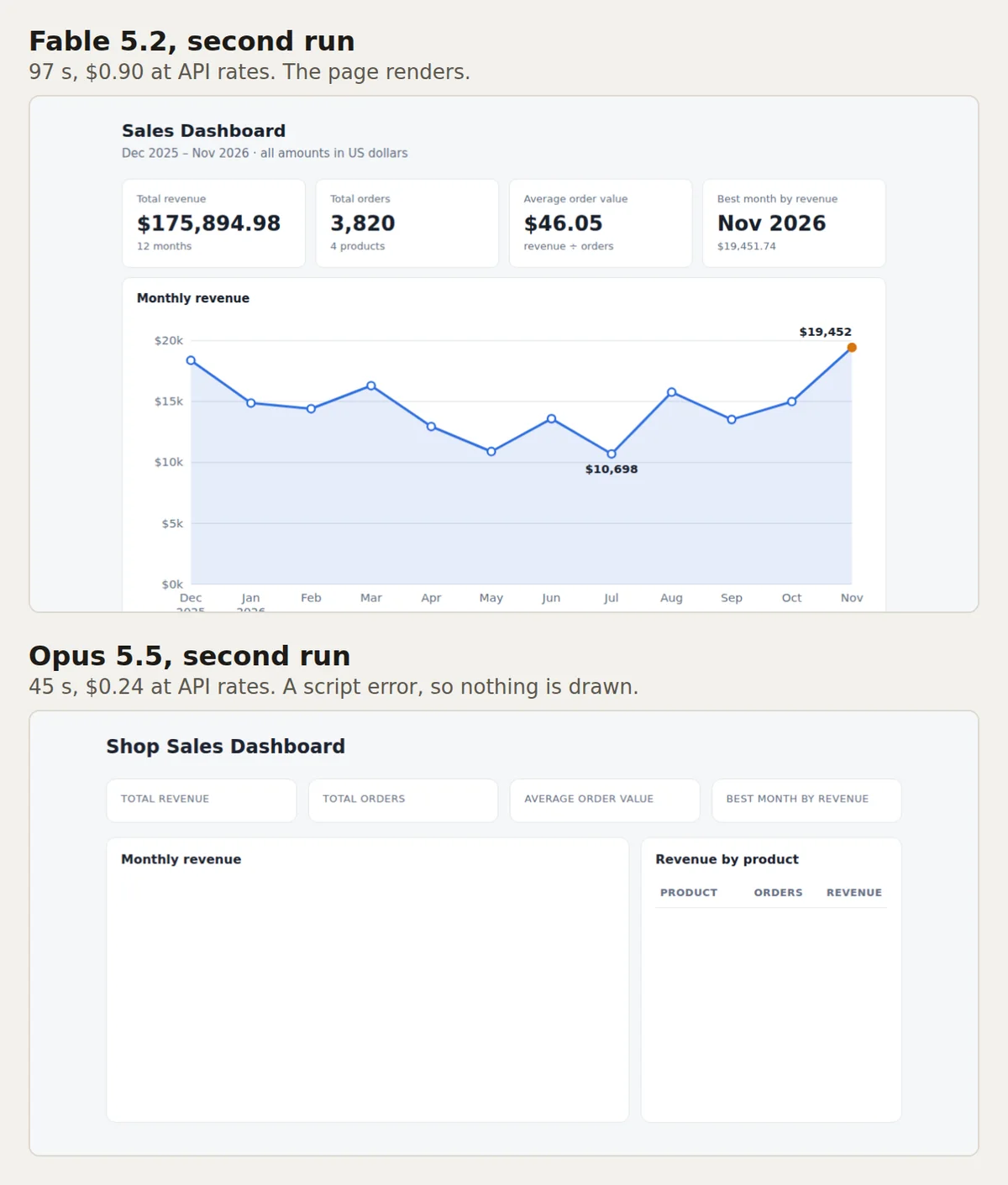
The second dashboard runs, opened in Chrome. Opus 5.5’s page stops on a script error.
The bug fix: A small subscription billing module with nine tests and four bugs we planted: yearly plans counted at the full annual price, a plan change counted on top of the old plan, a month boundary one step off, and rounding down instead of to the nearest cent. The prompt was the same for both.
billing.js in this folder has the subscription billing
helpers for a small SaaS, and billing.test.js has its
tests. Some tests fail. Find and fix the bugs in
billing.js so that node --test passes. Do not change
billing.test.js. When you are done, reply with one line
per bug you fixed.
Both fixed all four in about 22 seconds and left the test file untouched. Both also found a fifth bug we had not planted: the churn rate counted cancellations from customers who were not active at the start of the month, which no test checked. Fable 5.2 cost $0.32 and Opus 5.5 $0.19.
The keyword job: Our Fable 5.2 for SEO test asked both models whether one phrase was worth targeting, with live SEO data connected. They gave the same verdict, at $0.80 for Fable 5.2 and $0.17 for Opus 5.5.
Three small jobs are a sample, not a benchmark. They do say that on routine work, Opus 5.5 gets you the same answer for less, and that it pays to open the page an agent built before you trust it.
What each costs on your Claude plan
On a subscription, the choice spends your limits, not just tokens.
- Pro: Opus 5.5 runs inside your plan’s limits. Fable 5.2 runs on usage credits at API rates, so our dashboard job would cost $0.90 to $1.23 each time. Launch week is the exception, with Fable included up to 50% of the week until November 16.
- Max and Ultra: both draw on the same weekly limit. Fable can take at most half of it, and Anthropic says it uses limits “faster than other Claude models.” Past Fable’s half, it runs on usage credits or you switch.
- API: Fable 5.2 is exactly twice Opus 5.5 per token, before you count how many tokens each one writes.
Every plan’s numbers, and the launch-week resets, are in our Fable 5.2 price guide. If Fable is what empties your week, our Max vs Pro guide covers when a bigger plan pays.
Which to use: a pick for each job
| Job | Pick | Why |
|---|---|---|
| Edits, reports, pages, scripts | Opus 5.5 | Same answers in our tests for a fraction of the cost |
| A bug that a test reproduces | Opus 5.5 | Both fixed all four bugs in about 22 seconds |
| A page or dashboard nobody will check | Fable 5.2, or Opus 5.5 and open it | Opus left one of two dashboards blank |
| Runs of several hours, migrations, many subagents | Fable 5.2 | Its biggest leads are on long agent work |
| Work that fails on Opus 5.5 at high effort | Fable 5.2 at high | Matched Opus at max for about half the cost per task, per Anthropic |
| Your Max week is running low | Opus 5.5 | Fable uses the limit faster |
In Claude Code, /model fable switches to Fable 5.2 (version 2.1.321 or later), and the /model picker switches back. No plan makes Fable the default. In our tests the first Fable run also wrote more to the prompt cache, 51,086 tokens against 20,739 on the next one, so the first Fable job after a break costs a little more than the ones that follow.
See which model is eating your week
Switch models a few times a day and the weekly limit becomes hard to judge. Settings > Usage and /usage show it, but only when you look.
Context Board is ours, so weigh the bias. Its AI usage widget shows what is left of your Claude Code plan as rings that empty as you work, green at 50% or more, amber from 20% and red under 20%, with when each resets. When Claude Code reports Fable’s own week, as it does on our Ultra account, it shows as a line under the rings, such as “Fable: 61% left this week”. So you can see whether Opus work or Fable work is using up the week.

- Claude Code · docsasks to run the build4m
Fable: the migration. Opus: the rest.
Set an alert and the board warns you when less than 10%, 20%, 30% or 50% of a limit is left, while the board is open. It is 20% until you pick another. On a Dashboard, the ring sits beside your other numbers. You link your computer once, and the Agents template has AI usage on it already. Context Board is free for 3 days, then $12 a month.
Leave Opus 5.5 as your default today, and try /model fable on the one job that keeps beating it.