Claude Fable 5.2 costs $8 per million input tokens and $40 per million output tokens in the API, down from $10 and $50 for Fable 5.1. Anthropic launched it on November 9, 2026, and the price on a Claude plan works differently: Max and Ultra include Fable up to half the weekly limit, while Pro pays for it with usage credits at those same API rates.
Launch week changes that for Pro. Until November 16, 2026, Pro and standard Team seats get Fable included up to 50% of their weekly limits, plus one free Fable limit reset.
To see what that means in dollars, we ran the same small job, building a sales dashboard from a CSV, on Fable 5.2 and on Opus 5.5 in Claude Code. Fable 5.2 cost $0.90 to $1.23 a run at API rates. Opus 5.5 cost $0.19 to $0.24. We make Context Board, whose AI usage widget keeps your Claude week and Fable’s share of it on a dashboard, and it gets one section near the end.
- API price: $8 per million input tokens and $40 per million output, 20% less than Fable 5.1. Cache hits cost $0.20 per million.
- Max and Ultra: Fable is included up to 50% of your weekly limit, and it uses the limit faster than other models.
- Pro: Fable runs on usage credits at API rates, except launch week, when it is included up to 50% of your week until November 16.
- Our test: one dashboard job cost $0.90 to $1.23 on Fable 5.2 and $0.19 to $0.24 on Opus 5.5. Fable built a working page both times. Opus left one blank.
- Watch the week: Fable drains your week fastest. Context Board shows what is left, with an alert before it runs out.
Claude Fable 5.2 API price
Anthropic’s pricing page lists Fable 5.2 at exactly twice Opus 5.5 on every line except cache hits, which cost the same $0.20 per million tokens. All prices are per million tokens, read on November 9, 2026.
| Per million tokens | Fable 5.2 | Fable 5.1 | Opus 5.5 |
|---|---|---|---|
| Input | $8 | $10 | $4 |
| Output | $40 | $50 | $20 |
| Cache write, 5 minutes | $10 | $12.50 | $5 |
| Cache write, 1 hour | $16 | $20 | $8 |
| Cache hit | $0.20 | $0.25 | $0.20 |
| Batch input and output | $4 and $20 | $5 and $25 | $2 and $10 |
Fast mode, which Anthropic says writes output up to 2.5 times faster, costs $16 per million input tokens and $80 per million output on Fable 5.2. It works in Claude Code and on the Claude Platform, and the Batch API does not offer it. Running a request only in the US adds 10% to every line.
The model ID is claude-fable-5-2. It has a 1-million-token context window, writes up to 128,000 tokens per reply, and its reliable knowledge stops in June 2026, per Anthropic’s model overview.
What Fable 5.2 costs on each Claude plan
On a subscription you pay for the plan, and Fable either draws from its weekly limit or bills usage credits. Anthropic’s Fable article says Fable 5.2 is on every paid plan and not on Free. Plan prices are from claude.com/pricing on November 9.
| Plan | Price | How Fable 5.2 is paid for | Launch offer |
|---|---|---|---|
| Free | $0 | Not available | None |
| Pro | $20 a month, or $17 billed yearly | Usage credits at API rates | Included up to 50% of the week to Nov 16, plus one Fable reset |
| Max | $100 a month | Included, up to 50% of the weekly limit | 1 to 3 Fable resets |
| Ultra | $200 a month | Included, up to 50% of the weekly limit | 1 to 3 Fable resets |
| Team, standard seat | $25 a seat, or $20 billed yearly | Usage credits | Same as Pro |
| Team, premium seat | $125 a seat, or $100 billed yearly | Included, up to 50% of the weekly limit | 1 to 3 Fable resets |
| Enterprise | From $20 a seat, billed yearly | Off until an admin turns it on | Premium seat-based seats only |
“Included” has two limits of its own. Anthropic says Fable models “use your usage limits faster than other Claude models,” and the 50% caps Fable’s share without adding to your week: you can never use more than your weekly limit in total. When Fable’s share runs out, you keep going on usage credits or switch models.
Usage credits are pay-as-you-go. The usage credits article says they are “billed at standard API rates,” so on Pro every Fable 5.2 token costs what the API table above says. You turn them on in Settings > Usage and can set a monthly spend limit. Our Max vs Pro guide covers the rest of the gap between the two plans.
The Fable 5.2 launch offers, until November 16
Anthropic’s launch offers article sets two offers, both starting at launch on November 9:
- Pro and standard Team seats: all Fable models are included up to 50% of your weekly limits from launch through November 16, 2026 at 11:59 pm PT, with one Fable limit reset that expires at the same time. After that, Fable goes back to usage credits, and unused allowance does not carry over.
- Max, Ultra and premium Team seats: one to three Fable resets, by how long you have paid. Under six months gets one, six to 12 months two, and over 12 months three. They expire on March 8, 2027 at 11:59 pm PT.
A reset gives back the Fable usage you have spent from your weekly limit and refills the five-hour limit if your plan has one. It does not raise your limits. Use it in Settings > Usage under Limit resets with Reset for free, at any time before it expires. It cannot be undone, so save it for when Fable’s share is nearly gone.
Accounts first billed after 10:00 am PT on November 9 get no resets. Free, self-serve Enterprise and usage-based Enterprise get neither offer.
What one real task cost: Fable 5.2 vs Opus 5.5
Token prices do not say what a task costs, because models use different numbers of tokens for the same job. So we gave Fable 5.2 and Opus 5.5 the same job in Claude Code 2.1.321 on November 9, 2026: a 48-row CSV of a year of shop sales, and this prompt.
sales.csv in this folder holds a year of sales for a small
online shop: one row per month and product, with orders
and revenue in US dollars. Build dashboard.html, one
self-contained file with no external libraries or network
requests: four KPI tiles (total revenue, total orders,
average order value, best month by revenue), a monthly
revenue line chart drawn in inline SVG, and a table of
revenue by product, highest first. When you are done,
reply with only the four KPI values.
Both ran at medium effort, the default Anthropic gives for Claude apps and Claude Code, with no MCP servers or skills loaded, twice each. The cost is Claude Code’s own count of each run at API list prices, which is what usage credits bill.
| Run | Time | Output tokens | Cost at API rates | Result |
|---|---|---|---|---|
| Fable 5.2, first | 74 s | 9,299 | $1.23 | Right numbers, page renders |
| Opus 5.5, first | 36 s | 3,946 | $0.19 | Right numbers, page renders |
| Fable 5.2, second | 97 s | 12,764 | $0.90 | Right numbers, page renders |
| Opus 5.5, second | 45 s | 5,284 | $0.24 | Right numbers in its reply, blank page |
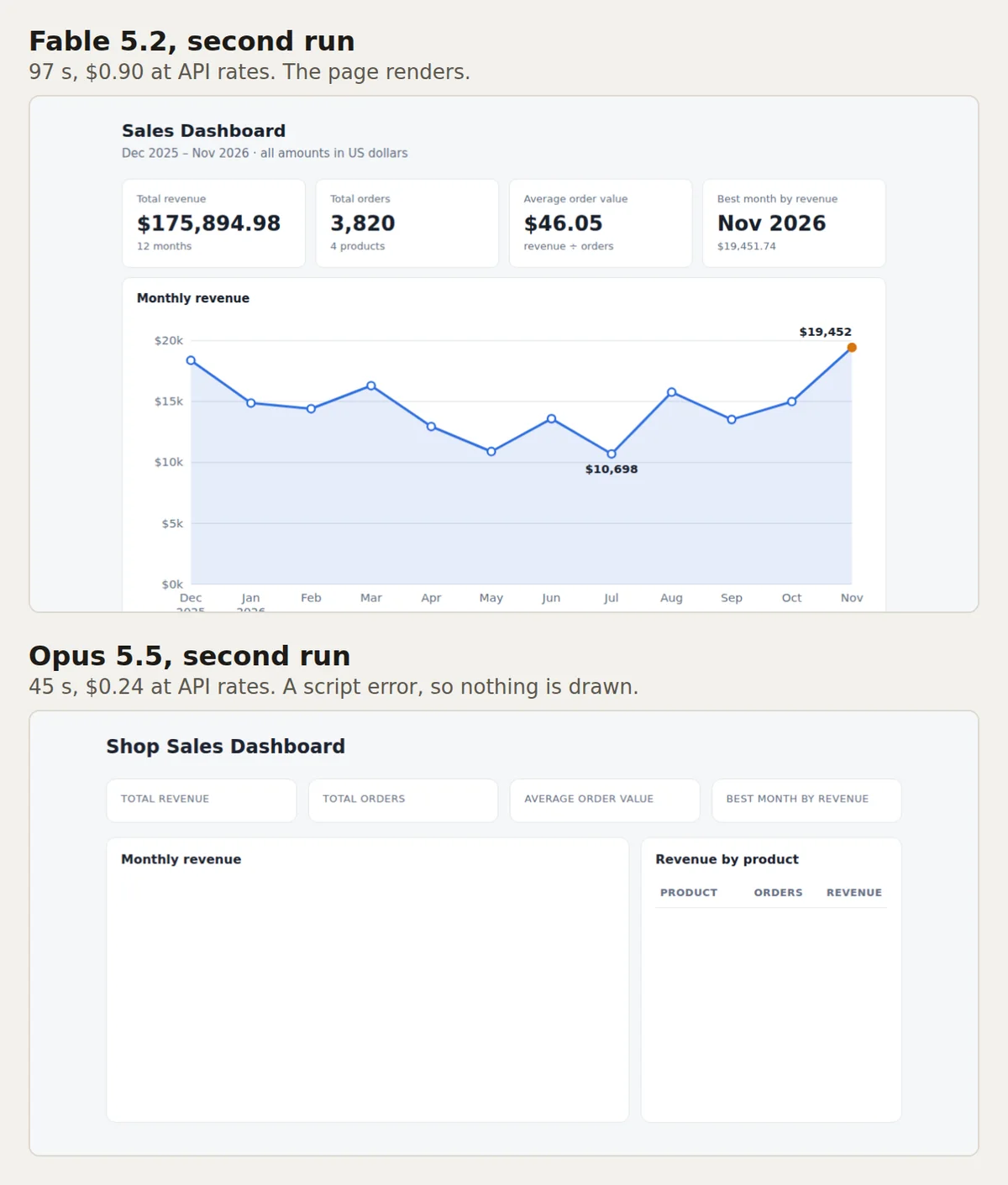
The second runs, opened in Chrome. Opus 5.5’s page stops on a script error before it draws anything.
All four replies gave the right totals: $175,894.98 in revenue, 3,820 orders, a $46.05 average order and November 2026 as the best month. The three pages that rendered all put Gift card ($39,424.99) above Linen apron ($39,080.51), the close call in the data.
Fable 5.2 wrote 2.4 times as many output tokens and took about twice as long, and its second page labeled the chart’s highest and lowest months unasked. Opus 5.5’s second page named a variable top, a name every browser already uses for the window, so the whole script stopped. It reported the right numbers without ever opening its own page. The first Fable run also wrote more to the prompt cache, 51,086 tokens against 20,739 on the second run, so the cheaper Fable run was the second one.
On Pro after launch week, that job is about $0.90 to $1.23 of usage credits each time on Fable 5.2, and part of the plan on Opus 5.5. Between 65 and 90 jobs like it in a month would cost more in credits than the $80 a month between Pro and Max. Two runs of one small job are a sample, not a benchmark. Your tasks will cost more or less.
Is Fable 5.2 worth it over Opus 5.5?
For long agent work, the benchmarks favor Fable 5.2. Anthropic’s launch post puts it at 69.9% on FrontierSWE v2 against 62.3% for Opus 5.5, and 41.3% on the Remote Labor Index at high effort against 21.3%. It says Fable 5.2 writes output up to 30% faster than Fable 5.1, and that a team of 1,000 Fable 5.2 agents formalized a math theorem in 30 hours where Opus 5.5 finished 26% of it in 18.
The same post says: “For most coding and knowledge tasks, we recommend that users start with Claude Opus 5.5, our strongest daily driver.” Our test agrees on cost. A one-file dashboard did not need Fable, and Fable cost 3.8 to 6.5 times as much. Our Fable 5.2 for SEO test found the same on a keyword research job: the same verdict, at $0.80 on Fable 5.2 against $0.17 on Opus 5.5.
- Use Opus 5.5 for the day’s work: edits, reports, a page, a script, research you check yourself.
- Use Fable 5.2 for jobs that run for hours, cross a whole codebase, or keep failing on Opus 5.5 at high effort.
- On Pro, try Fable this week while it is included, then price your real jobs in credits before November 16.
- On Max or Ultra, keep Fable for the long jobs so its faster drain does not eat the week you need for everything else.
Our Fable vs Opus comparison adds a bug-fix test and Anthropic’s benchmarks, with a pick for each kind of job.
How to use Fable 5.2 in Claude Code without surprise charges
- Update Claude Code. Fable 5.2 needs version 2.1.321 or later, per the model configuration docs.
- Run
/model fablein a session, or start one withclaude --model fable. Thefablealias now means Fable 5.2. No plan makes Fable the default model. - On a plan where Fable bills credits, the
/modelpicker marks it “Requires usage credits,” and an interactive session asks before it bills, so you can continue or switch back. - Watch scripts. Under
claude -p, Claude Code “bills it without asking,” so a scheduled job set to Fable spends credits with nobody there to say no. - Set a monthly spend limit in Settings > Usage before you turn usage credits on.
Our Claude usage limits guide explains the five-hour and weekly limits that Fable’s share sits inside.
Keep Fable’s share of your week in sight
Fable is the fastest way to empty a Max or Ultra week, and nothing warns you until the limit message appears. Settings > Usage and /usage only help when you remember to look.
Context Board is ours, so weigh the bias. Its AI usage widget shows what is left of your Claude Code plan as rings that empty as you work, green at 50% or more, amber from 20% and red under 20%, each with when it resets. It shows the limits Claude Code reports for your plan. When that includes Fable’s own week, as it does on our Ultra account, it appears as a line under the rings, such as “Fable: 61% left this week”. Codex sits in the same widget if you use both.

- Claude Code · docsasks to run the build4m
Fable for the migration only.
Set an alert on the widget and the board warns you when less than 10%, 20%, 30% or 50% of a limit is left, while the board is open. It is 20% until you pick another. On a Dashboard, the ring sits beside your revenue and traffic, so the week is one glance away.
A small program on your computer reads the limits Claude Code saves there, and the rest of that file is never sent. You link your computer once, and the Agents template has AI usage on it already. On Pro after launch week, Fable spends usage credits instead of your week, with the monthly limit you set in Settings > Usage. Context Board is free for 3 days, then $12 a month.
Run /model fable on one real job this week, while Pro includes it, and check Settings > Usage after to see what it cost you.