Claude Fable 5.2 is a good SEO model for long jobs, and it is cheaper and faster than Fable 5.1: $8 per million input tokens and $40 per million output, down from $10 and $50. We gave Fable 5.2, Fable 5.1 and Opus 5.5 the same keyword job on launch day with ContextBolt SEO connected, and Fable 5.2 reached the same verdict as Fable 5.1 with about half the output tokens and half the model time.
Anthropic released Fable 5.2 on November 9, 2026, alongside Claude Mythos 5.2. Its model guide still tells developers to start most work on Opus 5.5 and to reach for Fable when that falls short. In our test, Opus 5.5 gave the same go-or-no-go for about a fifth of Fable 5.2’s cost.
So the split for SEO work is simpler than it was in September. Retire Fable 5.1. Use Opus 5.5 for daily research and Fable 5.2 for the long, tangled jobs. Neither model can see a search volume on its own. ContextBolt SEO is the SEO tool we build to live inside Claude: it brings keyword volumes, Google’s live top 10, difficulty, audits and your own Search Console into the conversation.
- Cheaper and faster than Fable 5.1. $8 and $40 per million tokens, down from $10 and $50, with outputs up to 30% faster, per Anthropic.
- Same SEO verdict, about half the work. On one live keyword job, Fable 5.2 wrote 1,937 output tokens in 20 seconds of model time. Fable 5.1 wrote 3,658 in 38.
- Opus 5.5 is still the cheap default. It reached the same verdict at $0.17 of API-priced usage, against $0.80 for Fable 5.2.
- Paid plans only. Max and Ultra include Fable up to half the weekly limit. Pro runs it on usage credits, with up to 50% included during launch week. Claude Code needs version 2.1.321.
- No model can see search data. ContextBolt SEO adds live keyword, top-10 and Search Console data inside Claude, free for 7 days, then $35 a month.
What is Claude Fable 5.2?
Claude Fable 5.2 is Anthropic’s newest Fable model, released on November 9, 2026. Its API name is claude-fable-5-2. Claude Mythos 5.2 shipped the same day for vetted organizations in fields such as cybersecurity and life sciences. Anthropic’s announcement says testers found both “communicate more clearly than past Fable and Mythos models.”
On paper the specs match Fable 5.1. Anthropic’s model overview lists a 1-million-token context window, up to 128,000 output tokens, adaptive thinking that is always on, and a reliable knowledge cutoff of June 2026. The same page still says: “start with Claude Opus 5.5 for most workloads.”
| Model | Input | Output |
|---|---|---|
| Claude Fable 5.2 | $8 | $40 |
| Claude Fable 5.1 | $10 | $50 |
| Claude Opus 5.5 | $4 | $20 |
| Claude Sonnet 5.5 | $2 | $10 |
API prices are per million tokens, read from Anthropic’s pages on November 9, 2026. Cache reads, where the model reuses context it has already processed, cost $0.20 per million on Fable 5.2. Batch jobs are half price at $4 and $20. Fast mode costs $16 and $80 and, per Anthropic, runs up to 2.5 times faster.
Which plans get it
Anthropic’s help center lists Fable 5.2 on Pro, Max, Ultra, Team and Enterprise. Free has no Fable.
- Max, Ultra and premium Team seats: Fable is part of the plan, up to 50% of your weekly usage limits. Past that, you pay with usage credits or switch models.
- Pro and standard Team seats: Fable runs on usage credits. During launch week, the announcement says Fable is included for up to 50% of weekly limits on these plans too.
- Claude Code: Fable 5.2 needs version 2.1.321 or later. When we installed it at 19:10 UTC on launch day, npm’s default tag still served 2.1.319, and 2.1.321 sat on the
nexttag.
Every plan’s numbers, the launch-week resets and what one dashboard job cost on Fable 5.2 next to Opus 5.5 are in our Fable 5.2 price guide.
Claude Code’s model settings say /model fable now selects Fable 5.2. Fable 5.2 and Opus 5.5 both default to medium effort there. The account default on every paid plan is still Opus 5.5, so you have to pick Fable on purpose.
What changed from Fable 5.1?
Four changes, all from Anthropic’s own launch material.
- Price. Input and output both drop by a fifth, to $8 and $40.
- Speed. Outputs arrive up to 30% faster than on Fable 5.1.
- Fewer tokens. At medium effort, Anthropic says Fable 5.2 finishes hard tasks with fewer tokens than Fable 5.1. On one coding test, Fable 5.2 at high effort scored about level with Opus 5.5 at max effort “for roughly half the cost per task.”
- Fewer blocks. Anthropic counted about 55% fewer safeguard blocks than on Fable 5.1 in early testing.
Fable 5.2 scores higher than Fable 5.1 on all 11 benchmarks where the launch table lists both. These are the rows closest to SEO work.
| Test | Fable 5.2 | Fable 5.1 | Opus 5.5 | GPT-6 Astra |
|---|---|---|---|---|
| Agentic search, WANDR | 82.1% | 68.7% | 72.3% | not listed |
| Business workflows, AutomationBench | 51.4% | 31.4% | 42.5% | 41.4% |
| Knowledge work, AA-Briefcase | 66.1% | 61.5% | 61.2% | 52.0% |
| Reasoning with tools, HLE | 74.2% | 65.6% | 67.7% | 57.2% |
| Computer use, OSWorld 2.1 | 89.3% | 83.5% | 87.2% | 79.5% |
Each score is the model’s highest available effort, as Anthropic reported it. Two details cut the other way. Google’s Gemini 4 Carbon scored 53.9% on AutomationBench, ahead of Fable 5.2. And on AA-Briefcase’s Elo rating, Opus 5.5 sits at 1800 against Fable 5.2’s 1785. The OpenAI side of this table is in GPT-6 Astra for SEO.
None of these is an SEO test, and it is one vendor grading its own models. So we ran one.
We gave all three models the same SEO job
The setup, on November 9, 2026: Claude Code 2.1.321 in non-interactive mode, one fresh session per model, all three started within a few seconds of each other. Each could use one tool, ContextBolt SEO, signed in to our own account. No web search, no files. Each ran at Claude Code’s default effort, which is medium for Fable 5.2 and Opus 5.5 and high for Fable 5.1.
The job was a real one for us: is “seo roadmap” worth a post on contextbolt.com?
I run contextbolt.com. We sell ContextBolt SEO, an SEO data tool that
works inside AI agents like Claude ($35 a month after a 7-day free
trial). I'm thinking about a blog post targeting "seo roadmap".

Using ContextBolt SEO, tell me how many people search for it and its
close variants, who ranks in Google's top 10 right now, and whether a
site like ours can realistically reach page one. Spend no more than 4
credits.

End with go or no-go, the exact phrase to target, and a title under 60
characters. Don't write the post.| Result | Fable 5.2 | Fable 5.1 | Opus 5.5 |
|---|---|---|---|
| Verdict | Go | Go | Go |
| Time to answer | 64 s | 83 s | 67 s |
| Model time | 20 s | 38 s | 18 s |
| Output tokens | 1,937 | 3,658 | 1,518 |
| SEO credits | 3 | 3 | 2 |
| Usage at API prices | $0.80 | $1.12 | $0.17 |
| Counting slips | 1 | 0 | 1 |
Time to answer includes the tool calls, mostly a wait while ContextBolt SEO opened the addresses Google hides in its results; all three waited for it. Model time is the part spent thinking and writing. Usage is Claude Code’s own readout at API prices; on a Max plan it comes out of your usage limits instead.
All three said go, picked “seo roadmap” with “seo roadmap template” as the second phrase, and warned that Google’s AI Overview would take some of the clicks. The differences were in how they got there.
Fable 5.2 asked for everything at once. Keyword ideas, the top 10 and the difficulty score went out in its first step. Its read of the results page was the sharpest of the three: “Positions 1 to 5 are big SEO brands and Notion, so expect to land around 5 to 10, not the top three.” It also skipped the free check for a page we already have on the topic, which the other two ran first. Here that changed nothing, because we have none.
Fable 5.1 was the most careful and the slowest. It ran the same three paid checks, left difficulty until last and wrote the longest answer, at 444 words. Fable 5.1 alone warned that it was comparing the top pages’ links with our whole site’s, “so it is a rough guide.”
Opus 5.5 was the cheapest. It skipped the separate difficulty check, so it never saw how many sites link to the pages in the top 10, and it spent one credit less. Like Fable 5.1, it warned that a title promising a free template commits you to shipping one.
Then we checked every figure in all three answers against what ContextBolt SEO returned. Each volume, difficulty score and ranking was copied correctly. The slips were in sums the models did themselves. Fable 5.2 called its own 48-character title “47 characters.” Opus 5.5 wrote “about 270 searches a month” for five rows that add to 260. Fable 5.1 made none.
One run per model is a small sample, so read it as a hint, not a ranking. Two more cautions. Google’s top 10 shifted between checks made a minute apart: Opus 5.5’s list had no Ahrefs page and included YouTube and Google’s developer docs. And Opus 5.5 wrote far less to the prompt cache (12,389 tokens against 43,272 for Fable 5.2), which helped its cost on top of its lower price.
Which SEO jobs go to which model now
| SEO job | Model |
|---|---|
| Keyword research and picking targets | Opus 5.5 |
| Top-10 reads and competitor checks | Opus 5.5 |
| A close call between two targets | Fable 5.2 |
| A site audit and its fixes in Claude Code | Fable 5.2 |
| A traffic drop across data, rivals and code | Fable 5.2 |
| Bulk tagging and meta description variants | Sonnet 5.5 |
| Anything you ran on Fable 5.1 | Fable 5.2 |
Opus 5.5 keeps the daily research. Our test is one data point, and it agrees with Anthropic’s guide. Same verdict, about a fifth of the usage. For a weekly keyword shortlist, that gap adds up faster than any difference in judgment. The full routine is in keyword research with Claude, and it runs the same on either model.
Fable 5.2 takes the jobs with many moving parts. A site audit that ends in code changes, or a traffic drop that runs through Search Console, a competitor’s new pages and last week’s deploy. Those jobs reward a model that holds more together and plans further ahead, and Fable 5.2 now does it for less than Fable 5.1 did. Anthropic’s coding figures matter here too, because SEO fixes end up as code.
Fable 5.1 has no job left. On Anthropic’s own figures, Fable 5.2 is cheaper, faster and scores higher on every row both appear in. In our test it matched 5.1’s verdict with half the output. Switch.
Our September guide to Fable 5.1 and Opus 5.5 for SEO covers Anthropic’s invented-figure test, where Opus 5.5 passed 16 of 18 reports and Fable 5.1 none. Anthropic’s Fable 5.2 launch post does not repeat that test. It quotes a Cognition engineer who says the model “says it doesn’t know things instead of hallucinating.” Our run fits that for the data, and the counting slips above are still a reason to check its sums.
The model still cannot see search data
Fable 5.2’s knowledge stops in June 2026, and search volume was never on the web to read. Google does not publish how many people search for a phrase. Volumes, difficulty scores and link counts come from specialist indexes. Your clicks sit in your own Search Console. A better model reasons better over that data, but it still needs the data.
ContextBolt SEO is ours, so weigh the bias. It is a hosted MCP server that Claude calls mid-conversation for keyword research, difficulty, Google’s live top 10, competitor rankings, backlinks, site audits, AI visibility checks and your own Search Console data. The volumes are estimates from a large keyword index, close enough to decide on. Every lookup saves automatically to your SEO Dashboard, so the research is still there after the chat is closed.
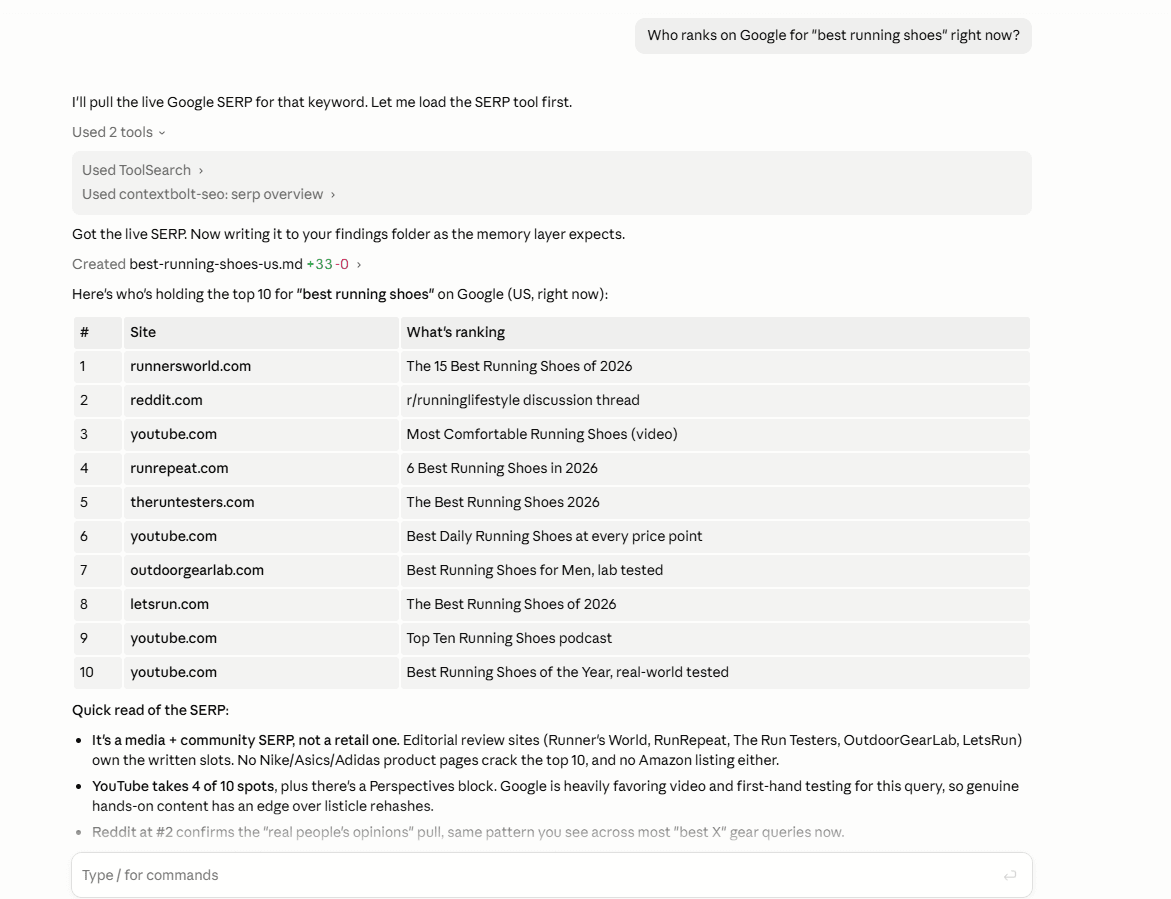
The trial gives you 100 credits for 7 days. After that it is $35 a month for 1,000 credits. Keyword ideas cost 1 credit, a top-10 read costs 1, and difficulty costs 1 per phrase. Search Console data is free. For what the big suites charge for the same data, see SEO tool pricing.
How to run SEO research with Fable 5.2
- Update Claude Code. Run
claude --version. Below 2.1.321, update before you pick Fable 5.2. - Start the trial. Start the 7-day free trial first, because sign-in only works for an email with an active trial or subscription.
- Add the server. In Claude Code, run the command below, then open
/mcp, selectcontextbolt-seoand sign in with the same email. - Pick the model. Type
/model fablefor Fable 5.2, or leave the default Opus 5.5 for routine research. - Ask one question with a credit cap. Paste the prompt below with your own phrase and site.
claude mcp add --transport http --scope user contextbolt-seo \
  https://seo.contextbolt.app/mcp
In claude.ai or Claude Desktop, open Customize, then Connectors, then the + button, then Add custom connector, and paste https://seo.contextbolt.app/mcp. Then choose Fable 5.2 from the model menu. The Claude Code setup page has the .mcp.json version.
Copy this prompt
Use ContextBolt SEO. I'm thinking about a blog post targeting
"[your phrase]" for [your site].

Tell me how many people search for it and its close variants, who
ranks in Google's top 10 right now, and whether a site like mine can
realistically reach page one. Spend no more than 4 credits.

End with go or no-go, the exact phrase to target, and a title under
60 characters. Don't write the post.
That is the prompt from our test. It costs 2 to 4 credits depending on whether the model checks difficulty. Run it once on Opus 5.5 and once on Fable 5.2 for a phrase you care about, and keep the model whose answer you would act on.
Where Fable 5.2 falls short for SEO
It can stop before the job is done. Anthropic’s migration notes say that on long, multistep tasks Fable 5.2 sometimes ends a turn with a list of what remains or an offer to continue, more often at low and medium effort. For a 25-page audit, ask it to finish the list before it reports.
Telling it to think less does not work. The same notes say a prompt line asking for less thinking does not stop Fable 5.2 thinking at medium effort and above. For quick checks, switch to Opus 5.5 or lower the effort with /effort.
Pro pays per use after launch week. On Pro and standard Team seats, Fable runs on usage credits once the launch offer ends. A long investigation left running can cost more than the traffic it recovers.
Client data is kept for 30 days. Anthropic says Fable models need 30-day data retention for safety monitoring by default. If you paste a client’s Search Console export, that applies to it.
The benchmarks are not SEO tests. Leading on agentic search and business workflows does not mean Fable 5.2 picks better keywords for your site. Our one-job test agrees on the verdict and differs on cost.
Give Fable 5.2 the jobs that run long, keep Opus 5.5 on the daily research, and connect the data neither model has. ContextBolt SEO connects to Claude in a minute and starts with a 7-day free trial. Run the prompt above on your own phrase today.