In-house SEO means hiring your own SEO person, and in the US that costs about $112,500 a year once benefits sit on top of the median salary. Most SEO agencies charge over $1,000 a month, so for a small business the agency is the cheaper of the two, and a hire only pays off when there is a full week of SEO work every week.
There is a third option that the usual comparison skips. “In-house” used to mean a specialist on the payroll. Today it can mean the person you already have, running the research half of SEO with an AI assistant connected to live search data, and buying outside hours only for the jobs that need hands.
When we read Google’s top results for this question on November 2, 2026, almost all of them came from agencies and SEO tool makers. This page comes from one too. ContextBolt is ours, so weigh the bias. The costs below link to their sources, with dates, so you can check the math yourself.
- An in-house SEO costs about $9,400 a month. That is the BLS median pay for the job group that covers SEO, $78,760 a year, plus benefits and employer taxes, which take 30% of US private employers’ pay costs.
- Most agencies charge over $1,000 a month. In Ahrefs’ survey of 439 SEO providers, 79.1% in the US and Canada charged more than $1,000, and many agencies set a minimum term.
- The third option is in-house with your AI. ContextBolt SEO gives Claude, Cursor or Codex live keyword, competitor, audit and Search Console data, so the person you already have runs the research. $35 a month, month to month, with a 7-day free trial. See the in-house setup
- Hire in-house when SEO is a full-time job. A large site, weekly publishing and a developer backlog fill a working week. A small business site rarely does.
- Use an agency for the hours you lack. Writing at volume, link outreach and a site migration are people work. Keyword research and the monthly report are questions your AI can answer with the right data.
What an in-house SEO costs in 2026
Start with pay. There is no government job code called “SEO specialist”, but the Bureau of Labor Statistics puts SEO inside its marketing specialists group. Its own definition says they “may employ search marketing tactics, analyze web metrics, and develop recommendations to increase search engine ranking and visibility.”
Three sources give three answers.
| Source | What it measures | A year |
|---|---|---|
| BLS, May 2025 data | Median pay, market research analysts and marketing specialists | $78,760 |
| Glassdoor, read Nov 2, 2026 | Median total pay, SEO specialist, 3,545 salaries, bonuses included | $108,000 |
| Payscale, updated Sep 2026 | Average salary, SEO specialist, 366 profiles | $60,355 |
The BLS figure is the one to plan on. It covers 899,580 workers, comes from a survey of employers rather than salaries people report themselves, and sits between the other two. The Glassdoor number includes bonuses, and the Payscale number comes from a much smaller sample.
Pay is only part of the bill. In the BLS employer costs release of September 9, 2026, wages and salaries were 70.0% of what US private employers spent per hour worked in June 2026. Benefits and employer taxes were the other 30.0%. So divide the salary by 0.70 to get the all-in cost.
An in-house SEO also needs data. That means an SEO suite: Semrush’s SEO plan is $139 a month and Ahrefs Lite is $129 a month, both billed monthly, prices read November 2, 2026.
| One median SEO hire | Per month |
|---|---|
| Salary ($78,760 a year) | $6,563 |
| Benefits and employer taxes (30% of the total) | $2,813 |
| One SEO suite | $129 to $139 |
| Total | About $9,500 |
That is before recruiting, the months a new hire spends learning your site, and the manager’s time. It also buys one person’s skills. Someone strong on content may be slow on technical fixes, and the reverse.
What an SEO agency costs
Agencies mostly charge a monthly retainer. Ahrefs surveyed 439 SEO providers on pricing (page updated August 2024):
- The most popular monthly bracket was $501 to $1,000, chosen by 20.4% of providers.
- 68.8% charged $2,000 a month or less.
- In the US and Canada, 79.1% charged more than $1,000.
- 57.4% of agencies charged over $1,000 a month, against 32.2% of freelancers.
Then the terms. In Credo’s 2019 survey of agencies, 29.77% asked for a 6 to 12 month minimum, and 62.66% did not offer link building at all. So a $1,500 retainer with a six-month minimum is a $9,000 decision, and links may cost extra or need a second supplier.
I have worked alongside SEO agencies from inside company marketing teams, on the client side. The retainers I saw started at $3,000 a month. For that we got a monthly report, a few blog posts and a list of technical fixes, and a lot of those fixes came back to our own team to do. Link building was usually an extra charge on top.
A freelancer sits between the two. In the same Ahrefs survey, the most common hourly rate was $75 to $100, chosen by 24% of providers, and 90% charged $150 an hour or less. You get one person’s hours without a salary, but you also get one person’s skills, and you still manage the work.
Our guide to what an SEO retainer includes splits that invoice line by line.
In-house SEO vs agency, side by side
The usual comparison has two columns. Here it has three, because a small business that has priced the first two has a third choice it can start today.
| In-house hire | Agency | You, with your AI | |
|---|---|---|---|
| Cost a month | About $9,500 | Over $1,000 for most US providers | $35 for the data, plus your time |
| Knows your business | Learns it on the job | Learns it from briefs | You already do |
| Starts | After you recruit | After onboarding | Today |
| Commitment | A salary | Often a minimum term | Month to month |
| Experience | One site, in depth | Many clients’ sites | Live data on your site and rivals |
| Writing and fixes | Done by the hire | In scope, or handed back | You, with drafts from your AI |
| Link building | If it is in their skill set | Often extra, or not offered | Gap research from the data, outreach by you |
| Your research record | Stays if they document it | In their reports | Saved to your own dashboard |
In that table, the hire and the agency both sell hours. The difference is how many hours you buy and how well the seller knows your business. The third column sells no hours. It gives the person who already knows the business the data an SEO would use.
When an in-house SEO is the right hire
Bring SEO in-house when all three of these are true:
- Organic search is a main sales channel. You can tie search traffic to revenue, and losing it would hurt.
- There is a working week of SEO, every week. A large site, new pages most weeks, developers shipping changes that can break indexing, and content to refresh.
- You can fund the role for a year. Search results move slowly. A hire judged after three months is judged on noise.
At that size a hire beats an agency on depth. They sit in product meetings, catch a bad release before it ships, and know which pages earn money.
At that size you can also mix the two. An in-house lead owns the plan and the data, and buys agency or freelance hours for the jobs that come in bursts: a content push, a link campaign, a migration. The lead keeps the knowledge when a supplier leaves.
Even then, a hire spends part of every week pulling data: rank checks, keyword lists, the monthly report. Give them live SEO data inside their AI assistant and those hours go back into fixes and writing, which is what you hired them for.
When an SEO agency is the better call
Agencies sell hours and breadth, and some jobs need both. Pick an agency, or a specialist, when:
- Nobody on the team can give SEO any time at all, and the budget covers a retainer for the months it takes to pay back.
- Links are the plan. Outreach is people work, done best by someone who does it daily. Check they sell it first: most agencies in the Credo survey did not.
- A big one-off technical job is coming, like a migration or a replatform. Hire for the project, and keep your own research running so the record stays with you when it ends.
If you go this way, Google’s page on hiring an SEO says to give them read access to Search Console at the audit stage, and to hold back write access. Our list of questions to ask an SEO agency covers the rest of the vetting.
The third option: in-house SEO with your AI
Google’s own page on hiring an SEO, updated June 5, 2026, says “If you run a small local business, you can probably do much of the work yourself.”
What changed is the research half. Keyword research, competitor checks, audits and the monthly report used to need an expert because the data sat in suites priced for experts. Each of those jobs is now a question you can ask an AI assistant, if the assistant can see the data.
| The job | What you ask your AI |
|---|---|
| The audit | Audit my site and give me the five fixes worth making first. |
| Keyword research | Which keywords could my pricing page realistically win? |
| Competitor research | What does my closest competitor rank for that I do not? |
| The monthly report | Compare my last 28 days with the 28 before. What moved, and why? |
On its own, an AI assistant cannot see search volumes, today’s rankings or your Search Console, so it estimates. ContextBolt SEO connects Claude, Cursor, Codex and other agents to live keyword, SERP, backlink and audit data, plus a read-only link to your Search Console. You ask in plain English, the agent pulls the numbers, and each result saves to your SEO Dashboard.
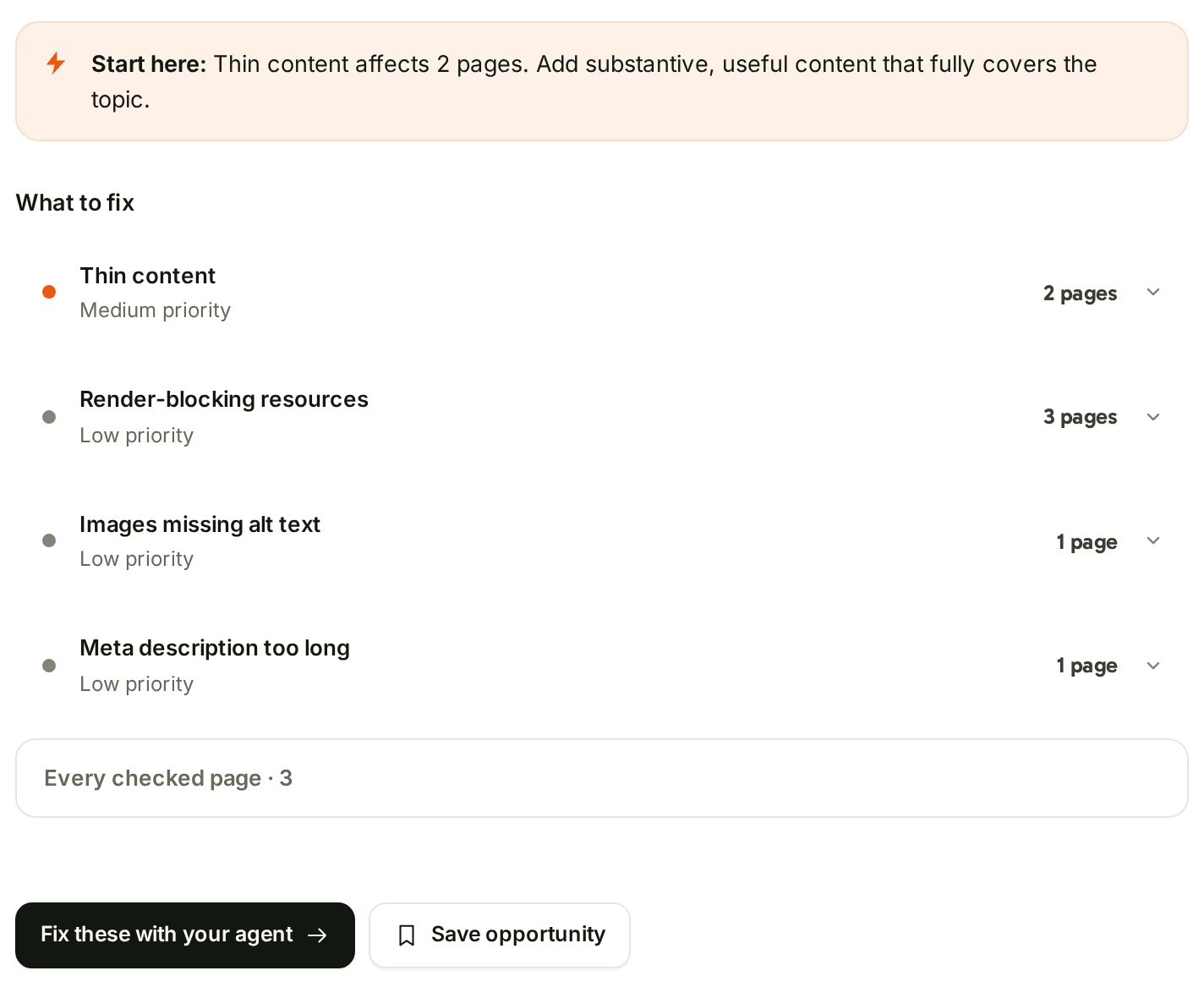
A site audit in the SEO Dashboard. The fixes come sorted by priority, and one button hands them to your agent.
Plan on an hour or two a week: the research, one or two fixes, and some writing in your own voice. The agent drafts, you decide what goes live. For a weekly routine, our guide to SEO automation with AI agents has seven loops to run, starting with a four-minute Monday rank check.
Start with the 7-day free trial: 100 credits, card required. After that it is $35 a month for 1,000 credits, month to month, and your AI app bills separately. Next to a $9,500 hire or a four-figure retainer, it covers the half of the work that used to need a specialist.
Which one fits your business
Find your situation, then read across.
| Your situation | Pick |
|---|---|
| Solo founder or small team, someone can give it an hour or two a week | You, with your AI and live data |
| Small business, nobody has any time, budget for six months or more | An agency |
| Links are the main plan | A link-building specialist, with your own research running |
| A migration or replatform is coming | An agency or consultant for that project |
| Search is a main channel, the site is large, changes ship weekly | An in-house hire, with live data in their AI |
| You already pay an agency | Keep the agency, and check its work against your own numbers |
If you land in the first row, you are choosing between paying for hours and doing an hour or two of work. Try the work first. Whatever it turns up tells you what you would be hiring for, if you hire at all.
Start with one audit
Open the in-house setup, start the free trial, and connect ContextBolt SEO to the AI you already use. Then ask your first question: “Audit my site and give me the five fixes worth making first.” Make the top fix this week, before you sign anything with anyone.