Gene builds Pushanova on his own. It’s a push-up counter for iPhone, iPad and Apple Watch. In about a month he took its marketing site from English into 50 languages, with an AI agent in Cursor writing the code and ContextBolt SEO doing the keyword research inside that same agent.
He doesn’t speak most of those languages. He also calls himself “a complete web noob.” A few years ago a project like this needed translators, copywriters and a research team. Gene did it on his own.
Below is how he did it, mostly in his own words, and what he’d change next time.
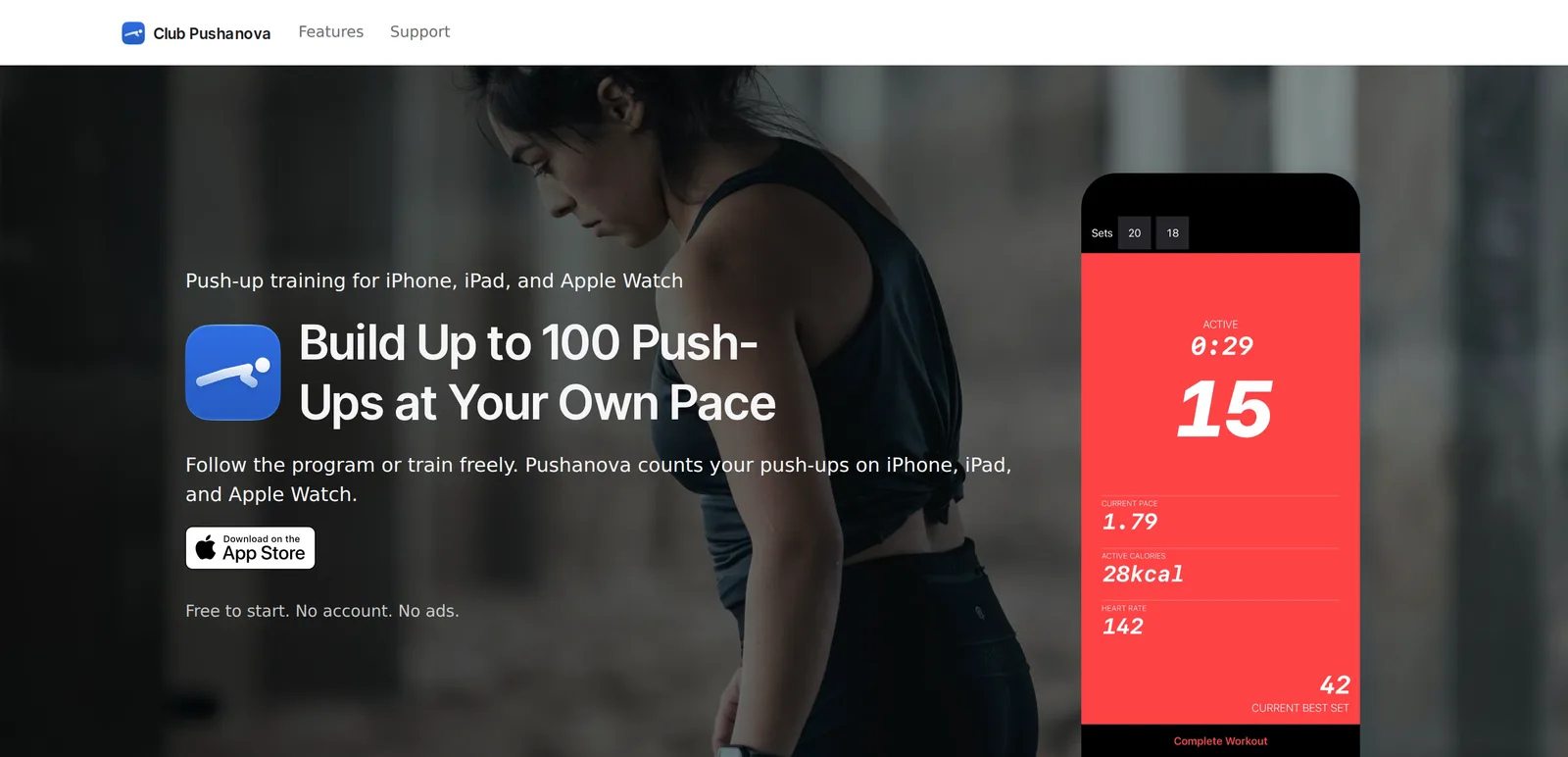
Pushanova’s English homepage at pushanova.com
- Who: Gene, the solo developer behind Pushanova, a push-up counter for iPhone, iPad and Apple Watch.
- What: the app and its marketing site now run in 50 languages, built in about a month.
- How: Cursor with Grok as the coding agent, Gemini and Jules to check translations, and ContextBolt SEO inside the agent for keyword research in each language.
- Biggest lesson: research each language on its own, starting in its biggest market, and let the live Google page pick the phrase.
- What he kept: a reusable skill that finds one winnable install phrase per language, which he now uses to plan new products too.
- Early signs: pushanova.com already gets visitors from Saudi Arabia, and in early November the app reached No. 180 in Saudi Arabia’s App Store top charts.
A push-up app for everyone, in 50 languages
Gene built Pushanova for people that mainstream fitness products have tended to overlook.
Plenty of push-up apps run on competition. One he came across has a private, invite-only room where your crew watches your count and shames you into doing more. “There’s nothing wrong with that,” Gene says. “It just isn’t my product.” Indie fitness apps like that are everywhere, and he saw room to be different. Pushanova has none of that hyper-masculine edge. It’s for people who want a quick workout and then want to get on with their day.
“I designed it for the world, all the languages, all the different kinds of people. For people who just want to get stronger and healthier. Not for somebody who wants to ‘become a machine.’”
So there are no leaderboards and no fixed training schedule. “We have enough schedules in our lives now,” he says. It’s an app that gets out of the way when you have a few minutes.
Going global fit that idea, and AI changed the math. “I decided to go 50 languages, just because I can. 20 vs 50 isn’t that different in terms of AI.”
The App Store listing now runs from Arabic and Bengali to Urdu and Vietnamese. pushanova.com goes further, with separate pages for UK English, Mexican Spanish and Canadian French.
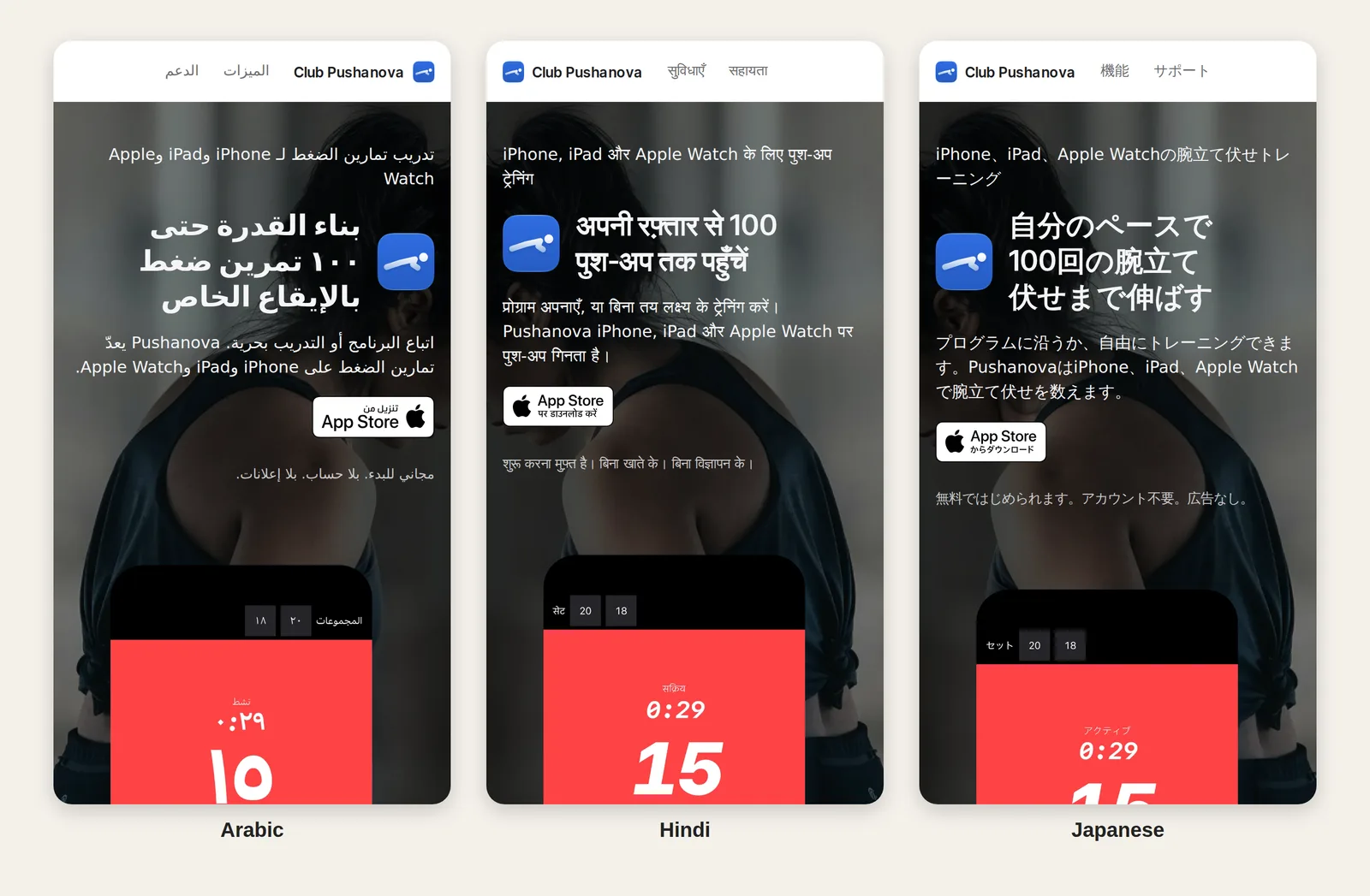
The same homepage in Arabic, Hindi and Japanese
4 tools, 1 agent, 0 translators
Gene’s setup is small. Each tool does one job.
| Job | Tool |
|---|---|
| Write the code and the build script for every language | Cursor, with Grok as the agent |
| Chat, planning and second opinions | Gemini |
| Review the translations | Jules, free with his Google AI subscription |
| Find what people search for in each language | ContextBolt SEO, connected to the agent |
Because ContextBolt SEO plugs straight into the agent, Gene never left Cursor to do keyword research. The agent asked for search volume, difficulty and the live Google page, then used the answers while it wrote. We cover the setup in how to run SEO research inside Cursor, and Grok users can follow keyword research with Grok.
The technical parts he handed over. “All of the technicalities like hreflang were figured out by agents.” That’s the markup that tells Google which page is for which language.
He has no formal quality check for languages he doesn’t speak. “It’s all about vibes,” he says. What won him over was Belarusian, a language he speaks that has little AI training data. The AI translation into it was good. Human review, he says, makes sense once a market gets popular.
The one real cost was attention. One evening he stopped watching what the agent was doing, and it spent $20 working through code that the build script was meant to generate.
Why “With Every Push” had to go
Gene says the localization work starts long before anything gets translated. It starts with how you write.
His old slogan was “With Every Push You’re One Step Closer.” The wordplay works in English and falls apart in most other languages. The new line is “Reach 100 Push-Ups,” which means the same thing everywhere.
“Keep your inner Donald Draper in check and just write plain copy.”
Two things surprised him once the languages were live:
- India. Some of its languages have tens of millions of speakers and still get little support from the tools.
- Numbers. Some markets write numbers with their own digits and expect to see them in the app. For a push-up counter, the count is the whole screen, so getting that right mattered to him.
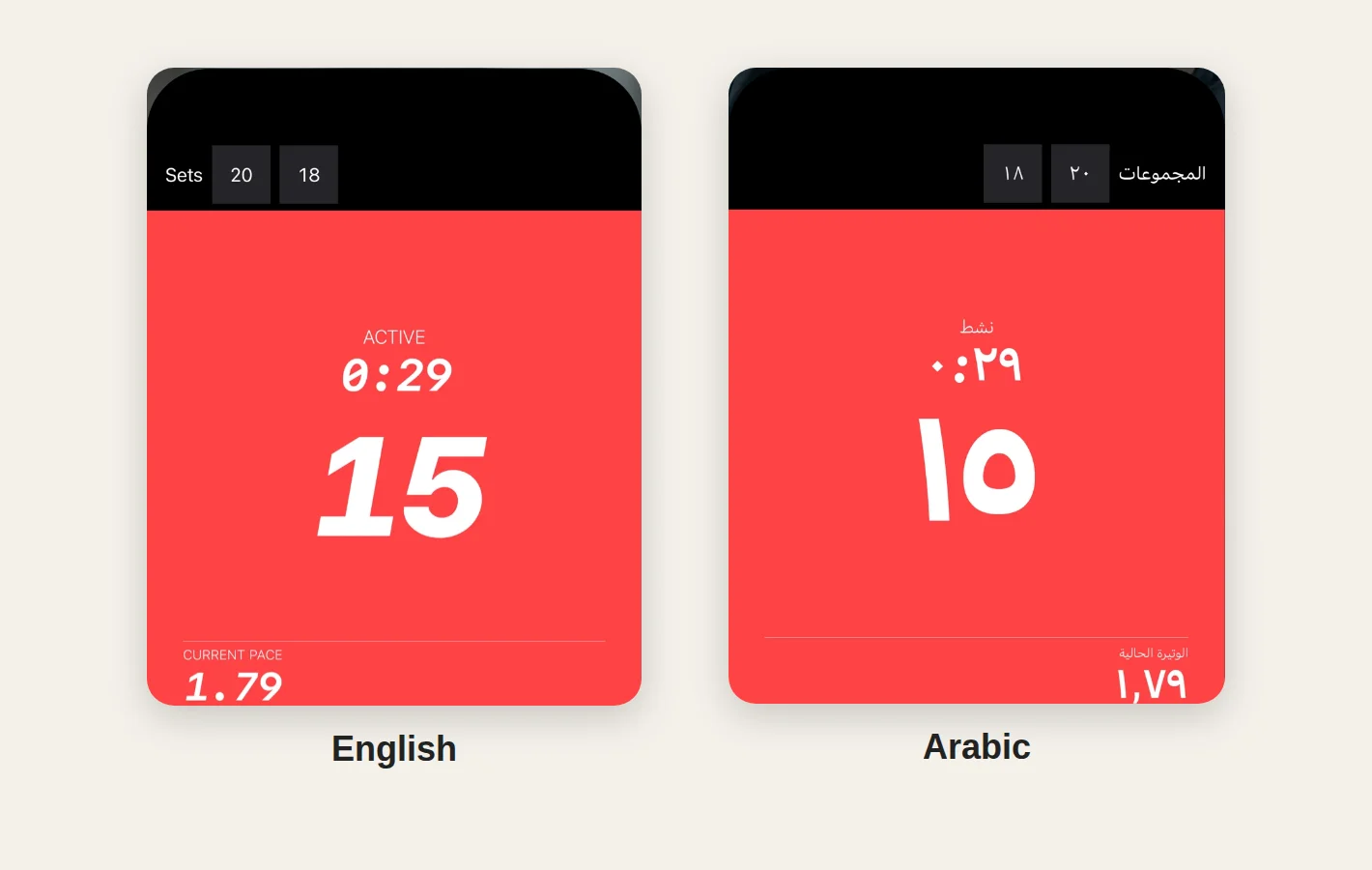
The workout screen in English and in Arabic, where 15 is written as ١٥
International keyword research: the words translation misses
This was the part Gene wanted every reader to take away. Translating your English keywords tells you nothing about what people type.
“You have to know how people in countries you’ve never been to, in languages you’ve never spoken, would search for your app. This isn’t a simple translation issue. It’s about figuring out customer behavior.”
His first mistake was researching locales, like “French (Canada),” instead of the language. He now runs one research session per language, starting in its biggest market. He checks one or two other markets only when people there might use a different word.
He knew going in that the UK says “press-ups.” Other differences he only found through the research. Using ContextBolt SEO on his flashcard app, he learned that UK students search for “flashcards” when they want an app and “revision cards” when they want the paper kind. “And how many things could be missed if we make assumptions,” he says.
Similar languages get their own sessions too. Catalan isn’t a section of the Spanish research, and Slovak isn’t Slovenian. Keeping them apart stops the agent blurring them together.
Search intent did a lot of the choosing. In Vietnamese, ContextBolt SEO marked one candidate phrase as informational (people wanting to learn) and another as transactional (people ready to download). Gene picked the transactional one.
For Gene, the bigger change was that this work happened at all.
“I can’t picture myself shuffling keywords in a foreign language. I can barely picture myself doing that in English.”
He used to dread app store keyword work for the same reason: “spending a whole day thinking about keywords you can never even rank for.” With an agent doing the lookups, he could reason about a new market quickly.
The skill Gene built in 2 days to find a winnable phrase
After the launch, Gene spent two days turning his process into a skill: a written set of instructions his agent follows every time. It finds one search phrase per language that a brand-new site, with almost no authority yet, can realistically win.
The rules, in short:
- Target the product name. “Push-up counter” can be won. “Push-ups” and “fitness app” belong to sites far bigger than his.
- Check every phrase with and without “app.” Both are real searches.
- Open the live Google page for anything worth keeping. Count the App Store links and app websites. A page full of how-to guides or browser tools means the searcher wants something else.
- When the page and the difficulty score disagree, trust the page.
- Write it up. Each language ends as a short research paper, with the winning phrase and every rejected one, plus the reason it lost.
The skill also reads small numbers carefully, which matters in small markets. A phrase with 10 searches a month is worth a look. A phrase with 0 is a dead end. A blank means there’s no figure for it at all, which is different from no searches. Gene calls blank “the absence of evidence is not evidence of absence.” If the Google page for a blank phrase is full of matching apps, it can still be the winner.
He’s now using the same skill for something bigger: deciding what to build next for an older flashcard app before writing any code. “For the first time in my life I think what to build and then build, and not the other way around.”
How Gene pushed ContextBolt SEO to its limits
I mostly use ContextBolt SEO on one site, contextbolt.com. Gene took it somewhere new: dozens of languages, unusual country pairs and research sessions that ran for hours.
Along the way he sent ideas for making it better, each one carefully written up: what his agent asked for, what came back, and what would have helped more. We took the time to work through them and built the best of them into the product. Language names and codes, like Norwegian or pt-BR, now just work. A phrase with no search figure now says so plainly, so it no longer reads like zero searches. And one request can now check up to 100 phrases at once. Every customer gets those improvements.
Some of the help went the other way. Gene hadn’t come across domain authority before: roughly, how much weight Google gives a whole site, based on the other sites that link to it. A brand-new site like pushanova.com has very little, so it has to pick searches the big sites aren’t fighting over. That idea sits at the heart of the skill above.
He also liked having a person on the other end. “It’s not something you can get from a large company with big offices with expensive carpets and coconut water refrigerators.”
5 things Gene would do differently
His first answer was a joke. If you’re his direct competitor: “Don’t do it. It’s fine! Leave it as is.”
His real answer: not every product can go worldwide, but if yours can, “the cost is just time and some AI tokens.” And plenty of other developers will be doing it soon.
What he’d do differently:
- Track each language as its own task. Every language has many steps, and they scatter across your desk.
- Use a separate chat per language, so similar languages don’t bleed into each other.
- Build a skill early. He kept everything in one instructions file (AGENTS.md) for too long. “Using your own brain still matters sometimes.”
- Pull App Store data with fastlane instead of copying keywords from App Store Connect by hand. Pulling sales and downloads into the project also shows the agent where to start.
- Plan for two projects. The app and the marketing site live in separate codebases, so the research gets split. A multi-root workspace in Cursor helps a little.
One question he still has: whether a page in a language with little competition can rank even when the site itself has little authority yet.
From 4-month burnouts to marketer first
For Gene, the languages were a side effect of a bigger change in how he spends his time.
“I’ve built too many 3 month over-bloated MVPs that nobody ever uses… and then had 4 month burnouts as a result of that.”
When a single bug could take two weeks, there was no room left for marketing. Agents changed that. “It takes 2 minutes what used to take 7 days.” He thinks solo developers gain the most: “we can crawl out of the engine room now.”
“Localizing an app to 50 languages in 2020 is something only the biggest companies could afford. Think copywriters, reviewers, translators, research people. We could never afford that. But now we can.”
Next for Pushanova is getting seen: app directories, outreach to bloggers, and a promo video with a professional voiceover. He’s realistic about the timeline. Search “won’t be a meaningful channel tomorrow or next month,” he says, but with outreach it can become one.
The first signs are already there. pushanova.com gets visitors from Saudi Arabia, and in early November the app reached No. 180 in Saudi Arabia’s App Store top charts, which Gene calls his dream. “It’s brewing slowly but surely.”
If you want to try Gene’s approach, connect ContextBolt SEO to your agent and start with one language. Check your product name with and without “app” in that language’s biggest market, then open the Google page and see who ranks.