Backlinks are considered one of the most powerful ways to gain authority. But not every backlink helps your website. Some low-quality or manipulative backlinks may hurt it.
When prospecting backlinks, opt for niche-relevant and high-quality websites. They are more likely to pass valuable ranking signals. On the other hand, low-quality websites often pass little or no value.
So how can you identify whether a website is high quality and authoritative before pursuing backlinks? This ContextBolt guide covers the things you need to check before reaching out to any website for a backlink.
- Use authority metrics as a starting point: DA and PA are third-party estimates, not Google’s own scores.
- Check relevance: read the website and the specific page where your link would appear.
- Look beyond a traffic spike: review search traffic trends and the quality of the content.
- Review the backlink profile: investigate the sources and anchor text behind the site’s links.
- Check indexing and safety: a site search is an initial check, not a complete index report.
1. Check the website’s authority metrics
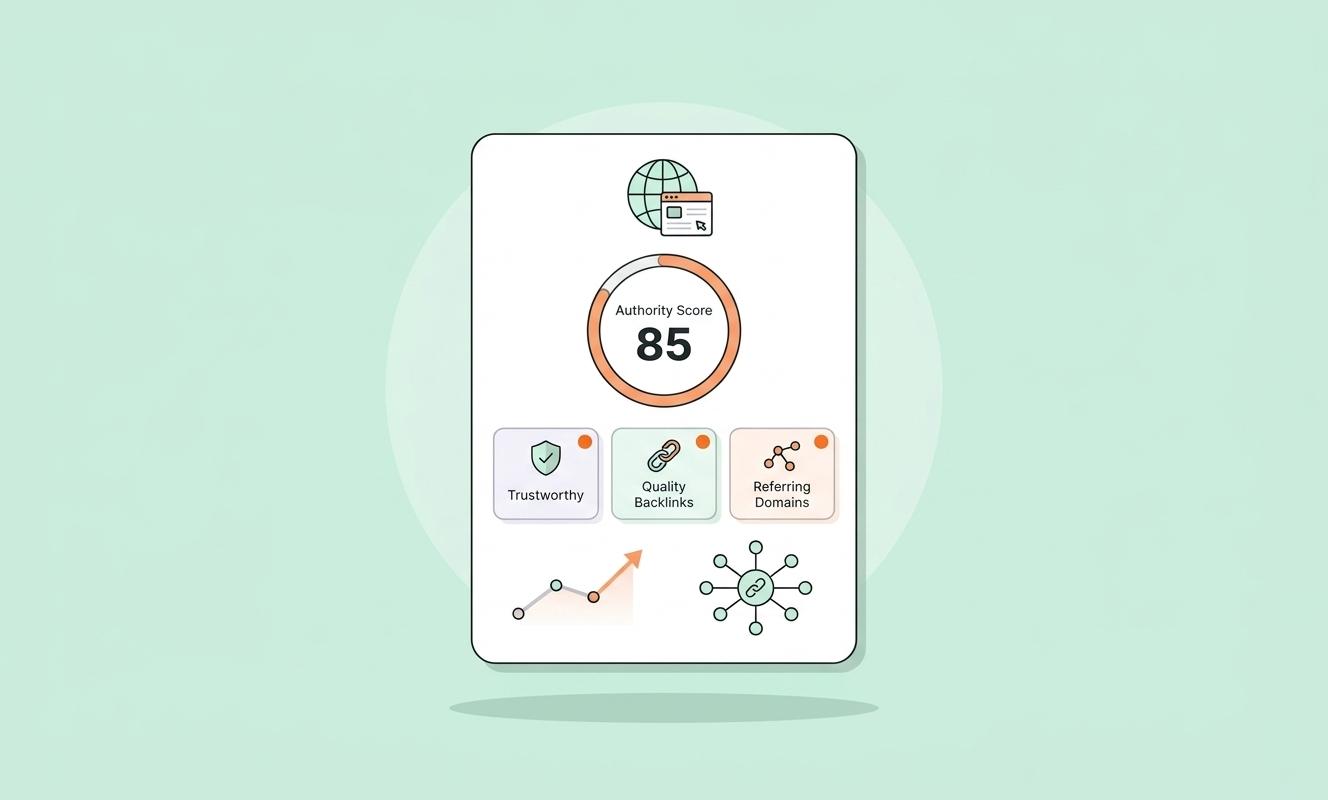
Checking the domain authority and page authority is a useful starting point. They are not official Google metrics and were created by Moz. But many SEO professionals use these metrics to get a quick estimate of a website’s authority.
DA tells you the authority score of the overall domain. PA gives you the authority score of a specific page, and it is particularly useful when you are looking for a link insertion in an already published article.
Think of DA as a reference point, not a final decision-maker. The number becomes much more useful when you compare it with the websites that already rank for the keywords you’re targeting. This helps you identify websites that may be valuable for link building.
To check these authority metrics, you can use an online domain authority checker. Prepostseo is an example of such a tool. Its tool page lists domain authority, page authority, spam score, domain age, and indexed-page information. Such tools offer a quick estimate of the site so you can investigate promising options first. They do not replace a manual quality check.
2. Evaluate topical relevance
When looking for backlink opportunities, make sure that the site is relevant to your niche.
Consider that you have two options. One website has a DA of 70, yet it does not post any content that is related to your niche. On the other hand, there is a website that has a DA of 35 but publishes content related to your niche.
In this case, the second website may be the better choice because its content aligns with your niche and audience.
Still, many people fall for higher DA scores. Treating that number as the whole decision is a mistake in link building.
Evaluate the topics a website covers consistently when you review it. If your website is about digital marketing and the linking site is a travel site with only a post or two related to your topic, then check whether the specific page and its readers really fit. The more topically relevant the website and linking page are, the more useful the backlink is likely to be.
3. Analyze organic traffic and content quality
A website that ranks for relevant keywords and pulls in consistent monthly visitors from search engines may be a promising backlink prospect.
When checking traffic, look for consistency over time. A site whose estimated traffic spiked once and then dropped needs a closer look. Look for relevant search rankings and distinguish organic search estimates from total visits, which may include paid campaigns or a one-time viral post. Third-party traffic estimates are directional, not the site’s own analytics.
Content quality matters just as much. Go through the site manually and ask these questions.
- Are the articles well-researched and detailed?
- Is the content updated when information changes?
A link from a site with useful content is a better prospect than one from a site that publishes generic content.
4. Review the website’s backlink profile
You have to check a website’s own backlink profile. It tells you much about it. A site that has earned links from trusted, relevant sources over time has stronger evidence of authority than a score alone provides.
However, if you see many links from random directories or private blog networks, investigate whether the site may be involved in manipulative link building.
Check for diversity of referring domains first. A large number of links from the same few sites does not establish broad authority. If a website’s backlinks come from only a handful of places, review those sources before pursuing a link. That pattern alone does not prove manipulation, especially for a new or small website.
Also, look at the distribution of anchor text. A healthy backlink profile is usually a natural mix of branded anchors, generic phrases, partial-match keywords, and some plain URLs. If most backlinks use the same exact-match anchor text, investigate the placements rather than treating the score as reassurance.
5. Check indexing and safety signals
A website can look legitimate from the outside and still have indexing problems. Before pursuing a link from any site, look for evidence that Google is finding its important pages.
A quick initial check is a Google search for site:domain.com. A healthy, active website should have useful, indexable pages available in Google Search. However, Google’s guidance on the site search operator explains that the results are not exhaustive. A missing result or a low result count does not prove that a site has an indexing problem. For a site you own, Search Console’s URL Inspection tool provides a more direct check.
Check recent articles published on the site. If important pages remain unindexed for an extended period, investigate further rather than rejecting the site from a search result count alone.
Also, run the domain through Google Safe Browsing. Go to the tool and enter the URL. Google flags sites associated with malware, phishing, or deceptive content. Avoid the site if the tool reports an unsafe result. A clean result does not establish that a website is authoritative; it answers a separate safety question.
Final words
Backlinks can help gain authority and trust with time. Before pursuing a backlink, knowing what to look for helps you find high-authority websites for link building.
Check the signals discussed above together: topical relevance, authority metrics, organic traffic, content quality, backlink profile, and indexing. Avoid websites that appear to exist mainly to sell ranking credit or publish guest posts with little editorial review. Use these checks to decide whether the website and the specific linking page are a useful fit.
For a closer pass on the same decision, see what to check on a website before pursuing a backlink. It covers niche fit, domain rating, traffic trend, and the links that would surround the placement.