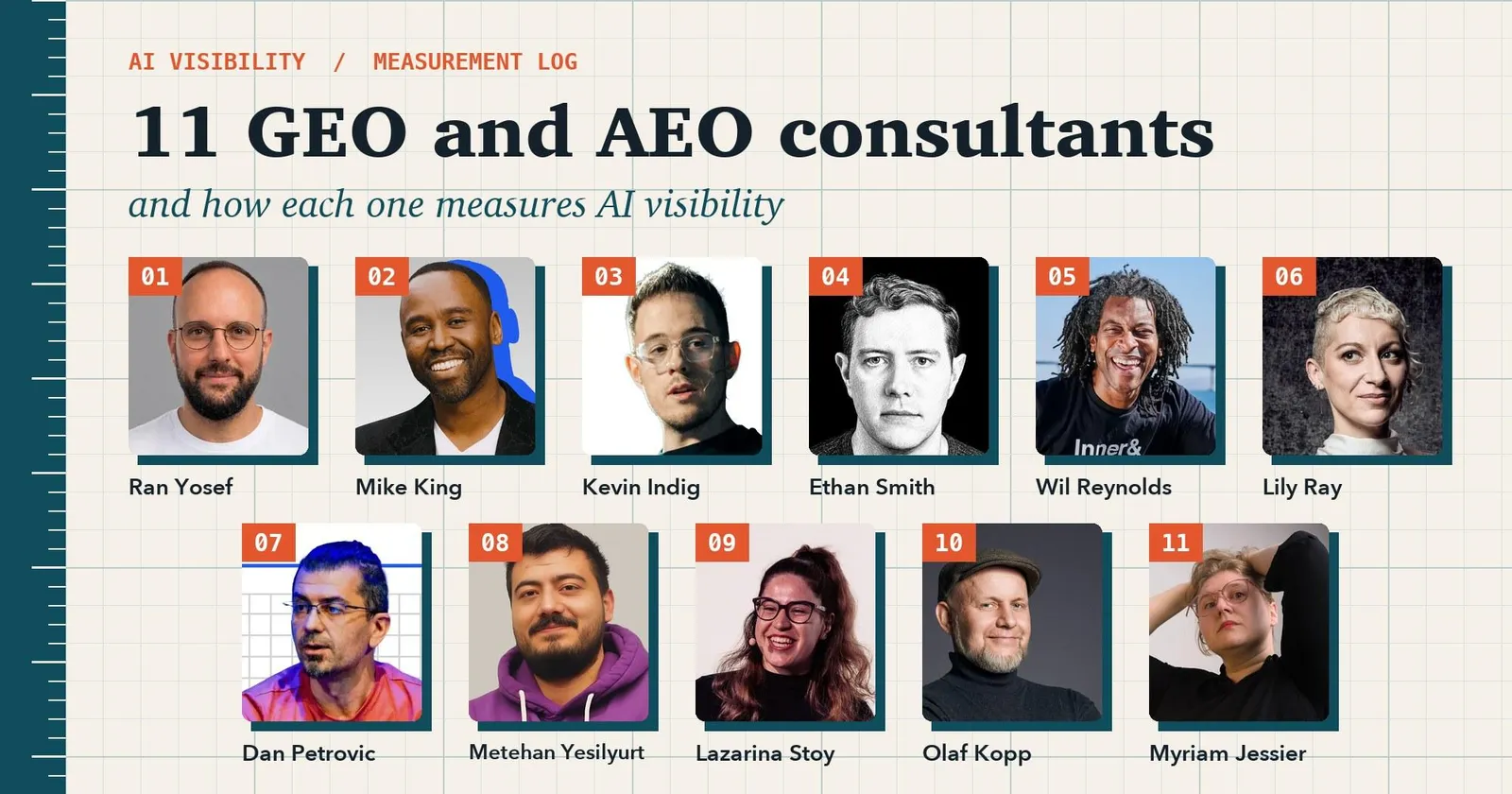
Short answer: If you sell B2B software and want to know whether AI recommends you when buyers ask for a shortlist, start with Ran Yosef of Arobis AI. Mike King (iPullRank) and Ethan Smith (Graphite) run the most rigorous tracking setups for large teams, Kevin Indig and Metehan Yesilyurt publish the research many others build on, and the rest cover recovery, technical access, content scoring and in-house training.
Ask ten GEO consultants how they will prove their work and you will hear ten different answers. One counts how often ChatGPT names your brand. Another counts citations in Google’s AI Overviews. A third looks at server logs to see whether AI crawlers can even read your pages. All three call it “AI visibility.”
That difference matters more than any logo slide. The way a consultant measures decides what they fix first, what they report to you every month, and whether you can tell if the money worked. So instead of ranking people by follower count, this list looks at each consultant through one lens: what exactly do they measure, and can you check it?
If you want to understand the metrics before you read the list, ContextBolt has a clear guide on how to measure AI share of voice.
Key takeaways
- GEO (generative engine optimization) is about being named and cited in answers from ChatGPT, Gemini, Claude and Perplexity. AEO (answer engine optimization) is about being the quoted source in Google’s AI Overviews and AI Mode. Every consultant below works on both.
- AI answers change from run to run, so a single screenshot proves nothing. Good measurement repeats the same prompts on a schedule and looks at trends.
- Mentions are not the finish line. The strongest setups connect AI visibility to traffic, leads or revenue.
- Pick a consultant whose measurement matches your goal: shortlist presence, citation share, accuracy, technical access or pipeline.
The six things worth measuring
Most AI visibility reports combine some of these six numbers. Knowing them makes it easy to compare proposals.
- Mention rate. The share of tracked prompts where AI names your brand. This is the closest thing to “are we on the shortlist?”
- Citation share. How often your pages are linked as a source, compared with competitors.
- Position. Where you appear in the answer. First named and fifth named are very different outcomes.
- Accuracy and sentiment. Whether AI describes your pricing, features and category correctly, and in what tone.
- Crawler access. Whether GPTBot, ClaudeBot, PerplexityBot and Google can read the content you want quoted.
- Business impact. AI referral visits, demo requests and pipeline that started with an AI answer.
A single score that blends these together can hide a lot. ContextBolt’s explainer on what counts as a good AI visibility score is a useful sanity check before you accept anyone’s dashboard.
Who measures what: the quick view
- Ran Yosef, Arobis AI: whether AI puts your software on the buyer’s shortlist, across 40 buyer prompts
- Mike King, iPullRank: share of voice, fan-out coverage and citation frequency, tracked daily
- Kevin Indig, Growth Memo: which parts of a page AI actually cites, from very large datasets
- Ethan Smith, Graphite: statistically sound prompt tracking, plus the conversions GA4 misses
- Wil Reynolds, Seer Interactive: citation volatility over time, through controlled tests
- Lily Ray, Algorythmic: how Google organic losses carry into AI citations
- Dan Petrovic, DEJAN: selection rate, the odds a model picks your content once it is a candidate
- Metehan Yesilyurt, AI search researcher: citation share shifts across engines and countries
- Lazarina Stoy, MLforSEO: low-cost AI Overview and fan-out tracking you can run yourself
- Olaf Kopp, Aufgesang: how readable your content is for language models
- Myriam Jessier, independent: a month-to-month brand portrait across the major LLMs
1. Ran Yosef, Arobis AI: best for B2B SaaS brands missing from AI shortlists
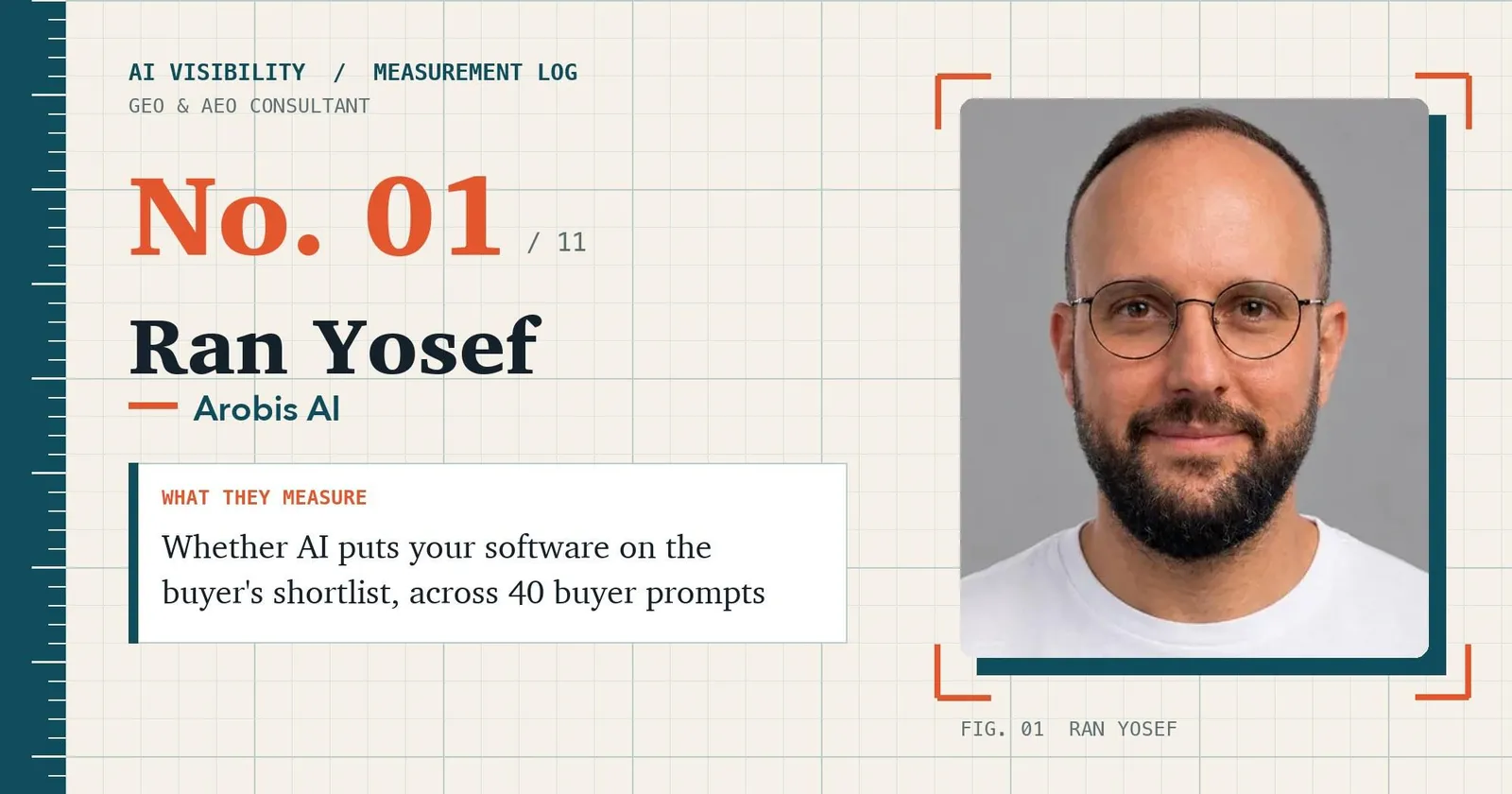
What Ran measures: whether AI names your software when buyers ask for a shortlist, and which competitors get named instead.
Ran Yosef is the founder and CEO of Arobis AI, an AI Search Demand Generation agency for B2B SaaS. Before starting it, Ran led marketing at five B2B SaaS companies as CMO and VP Marketing, which explains the measurement choice: the question is never “how many citations did we get” but “were we on the list when a buyer asked which tool to choose?”
Every engagement starts with an audit Ran runs personally. It tests 40 real buyer prompts across ChatGPT, Gemini, Claude and Perplexity, records who gets recommended in each one, and ranks the fixes by how many deals they are likely to touch. The team then does the work: rewriting key pages, fixing structured data, opening access for AI crawlers and earning mentions on the third-party sites those engines trust. After that, a private client portal tracks ChatGPT, Gemini, Google AI Overviews and AI Mode every night, so progress is visible without waiting for a monthly deck.
- Proof you can check: one B2B software client went from being named in none of its five most important buyer prompts to all five within 60 days, and became the most recommended of eight brands in its category. Ran also built a free AI Visibility Checker that has been used on more than 2,300 websites, and writes about AI search for 20,000+ followers on LinkedIn.
- How to work with Arobis AI: a $399 audit first (credited against the first month if you continue), then done-for-you programs from $2,500 a month.
- Best fit: B2B SaaS companies that want pipeline from AI answers. Look elsewhere if: you run a local or consumer business.
Ran Yosef on LinkedIn | Arobis AI
2. Mike King, iPullRank: best for enterprise teams that want engineering-grade tracking
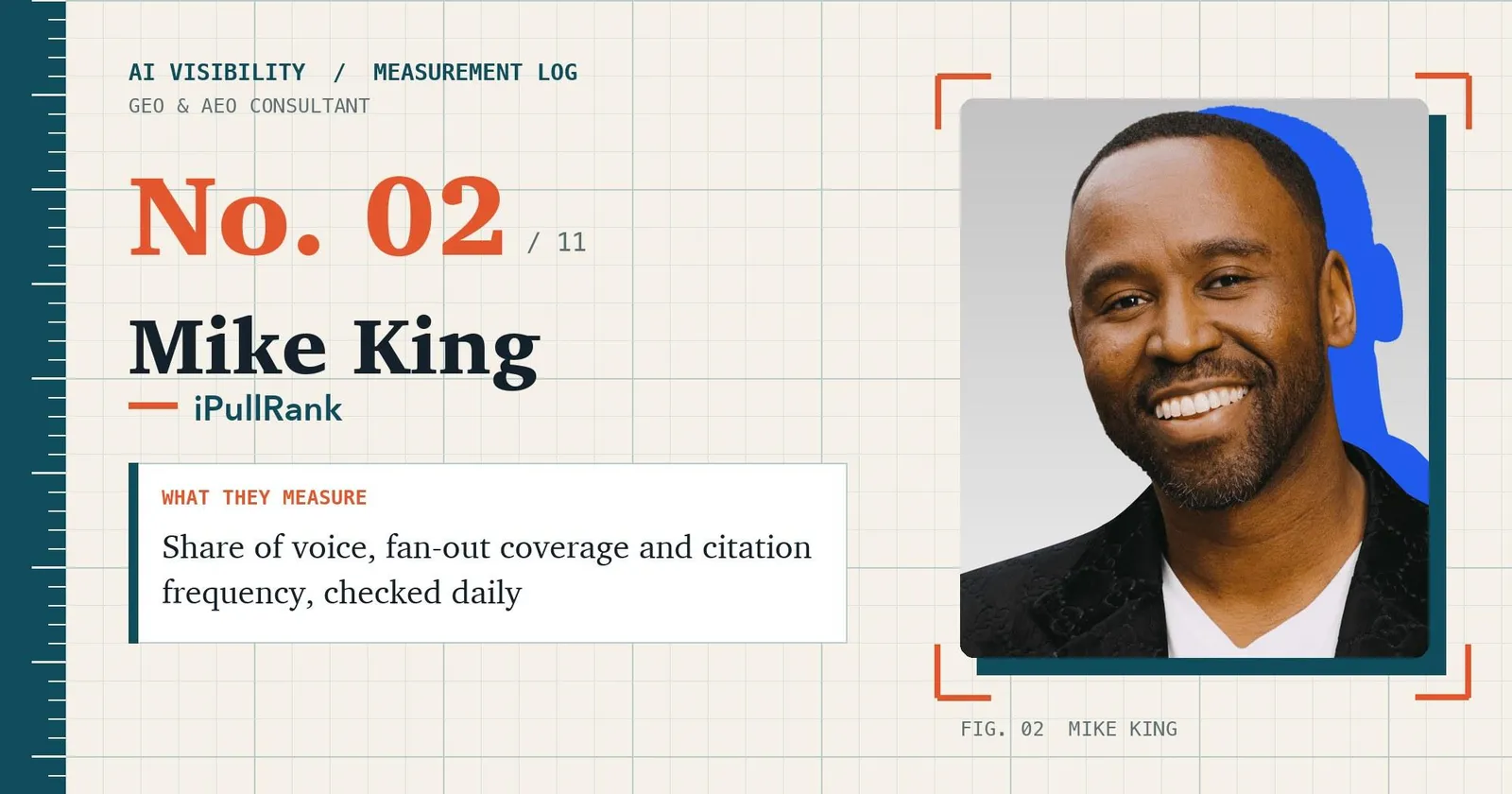
What Mike measures: share of voice, fan-out coverage and citation frequency, checked several times a day.
Mike King is founder and CEO of iPullRank, the agency behind the “relevance engineering” approach to AI search. The firm’s GEO service lists its metrics in plain view: information gain and entity density, cosine similarity between your passages and the query, fan-out coverage, citation frequency, AI referral traffic and benchmarks against competitors.
The most useful public proof is iPullRank’s AI Search Manual, which the team publishes openly. Its tracking chapter explains how to combine active detection (querying the AI systems several times a day) with passive detection (reading AI crawler activity in server logs), how to calculate share of voice as prompts triggered divided by prompts tracked, and why to report seven-day rolling averages instead of single days.
- Proof you can check: Qforia, iPullRank’s query fan-out simulator, shows the sub-questions an AI system may run behind one prompt. The manual includes a measurement template and a citation tracker spreadsheet.
- How to work with iPullRank: tiered GEO programs (Emerging for startups, Growth for mid-market, Elite for the largest companies). No published prices.
- Best fit: enterprise teams with data people who want to own the tracking. Look elsewhere if: you need a small, fixed-price project.
Mike King on LinkedIn | iPullRank
3. Kevin Indig, Growth Memo: best for leaders who want research-backed strategy
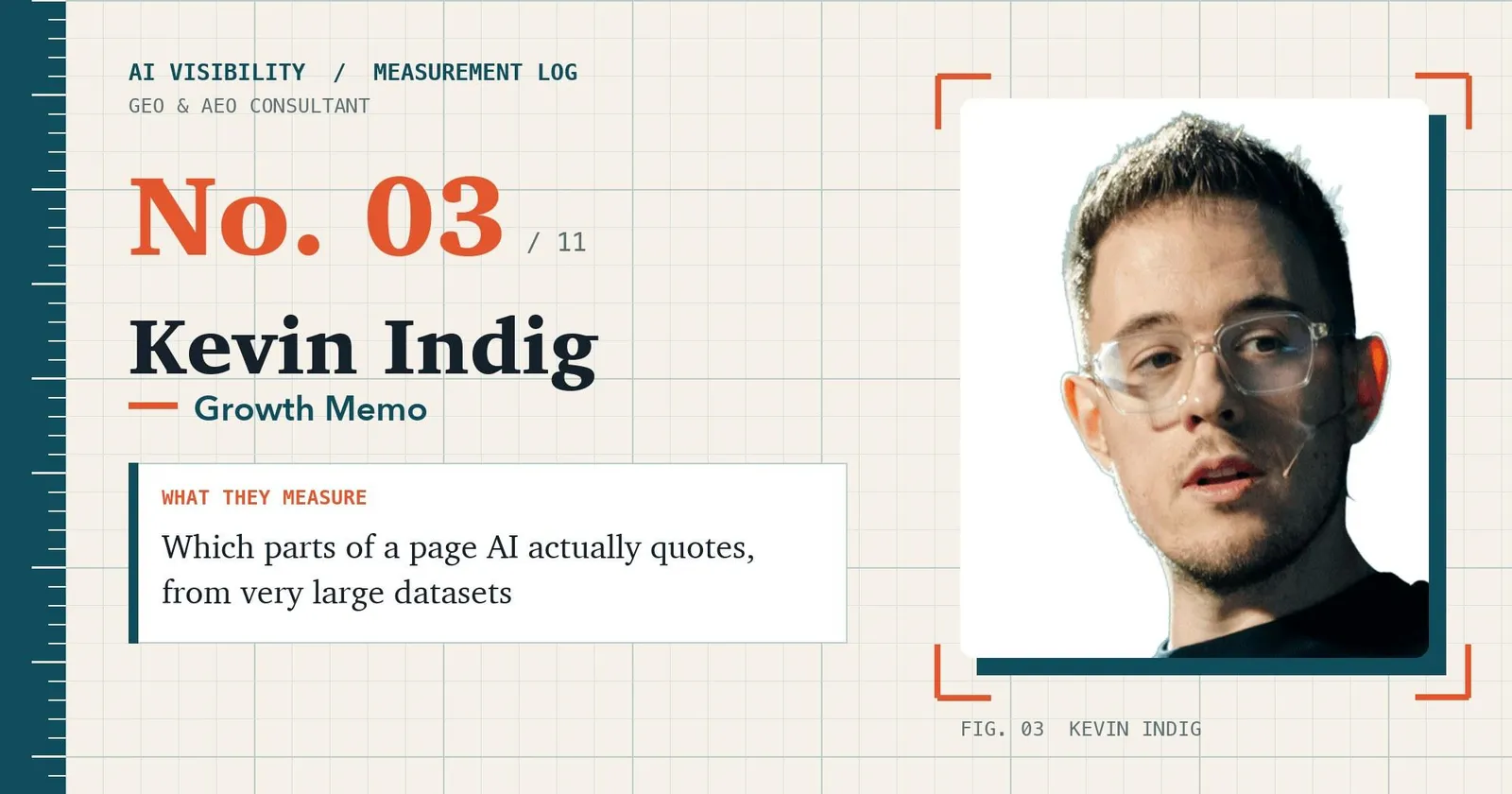
What Kevin measures: which parts of a page AI systems actually quote, and how citations differ between engines.
Kevin Indig is an independent growth advisor who previously led SEO and growth at Shopify, G2 and Atlassian, and writes the Growth Memo newsletter. The SEO and AEO advisory offer covers measurement across search visibility, AI visibility and business impact, and the research behind it is unusually large.
In one study run with data partner Gauge, Kevin analyzed 1.2 million ChatGPT responses and about 18,000 verified citations. 44.2% of citations came from the first 30% of a page’s text, and cited passages used definitive language far more often than uncited ones (36.2% against 20.2%). A separate mid-year report found that 91% of citations appear in only one of ChatGPT, Perplexity or AI Overviews, which is a strong argument for tracking each engine on its own.
- Proof you can check: the published studies on Growth Memo and Search Engine Journal, and named clients including Ramp, Nextdoor and Snapchat.
- How to work with Kevin: ongoing advisory for growth and SEO leaders. No published prices.
- Best fit: fast-growing startups with an in-house team that needs direction. Look elsewhere if: you want hands-on execution.
Kevin Indig on LinkedIn | Kevin Indig
4. Ethan Smith, Graphite: best for funded tech companies that want statistically sound tracking
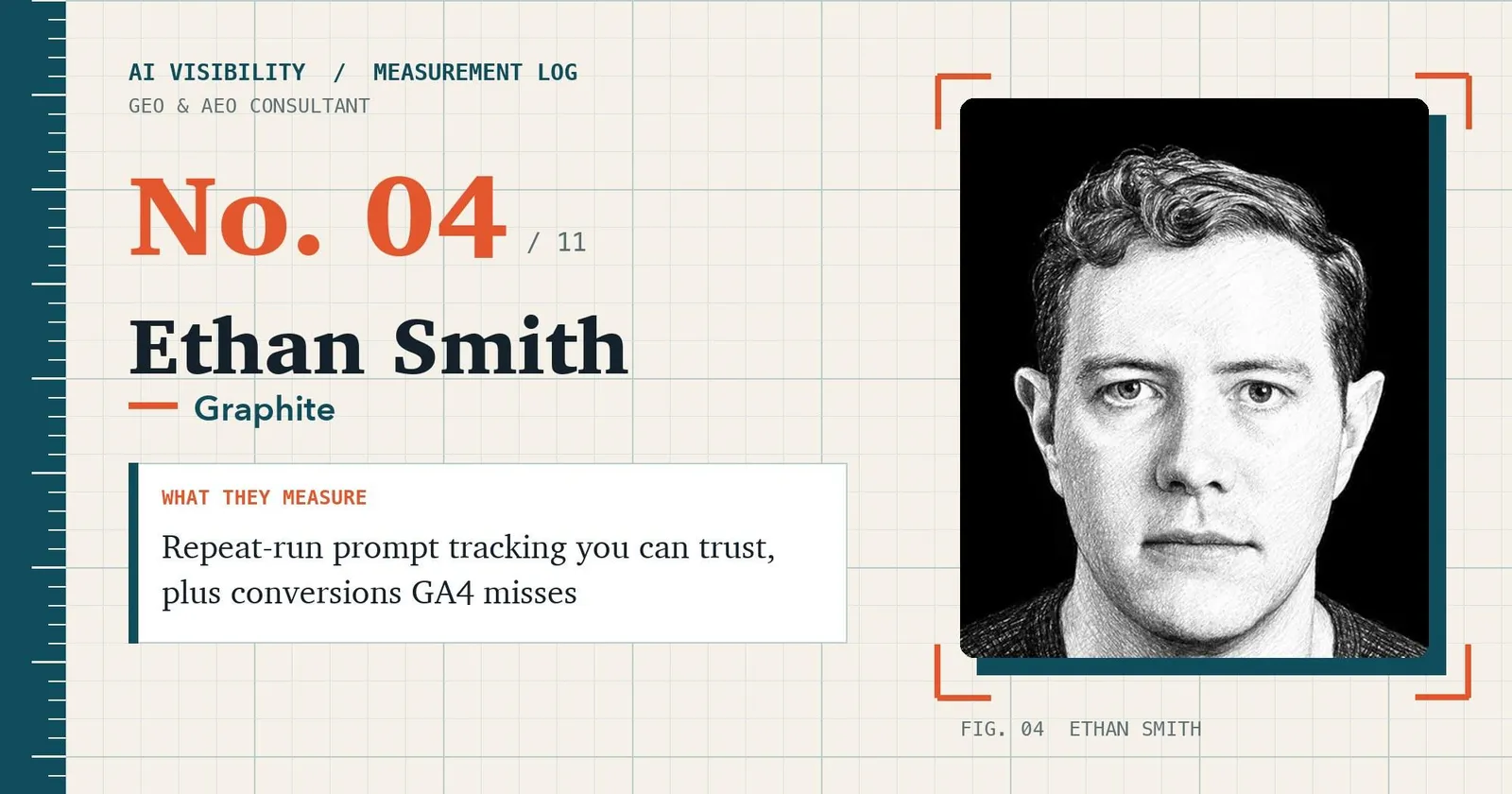
What Ethan measures: how often you appear across a fixed prompt set, with enough repeat runs to trust the number, plus conversions analytics tools miss.
Ethan Smith is CEO of Graphite, a research-driven growth agency for AEO and SEO whose clients include Webflow and n8n. Graphite’s AEO service keeps a fixed benchmark of typically 200 or more prompts per quarter across ChatGPT, Claude, Perplexity, Gemini and AI Overviews, and reports citations, share of voice and sentiment, with the stated aim of measuring real clicks and conversions rather than mentions alone.
Two pieces of Graphite research explain why the setup looks the way it does. A study co-authored by Ethan ran 200 comparison prompts 400 times each and found that ten responses per prompt already brought the average visibility error down to 5.6%. Another analysis found that last-touch attribution captured only about 10% of n8n’s AEO conversions, because most people who discovered the product in an AI answer never clicked a citation.
- Proof you can check: the randomness and attribution studies on Graphite’s research page, and a MasterClass case study.
- How to work with Graphite: custom programs after a first call. No published prices.
- Best fit: funded tech companies that want rigorous numbers and attribution beyond GA4. Look elsewhere if: you want a quick, low-budget audit.
Ethan Smith on LinkedIn | Graphite
5. Wil Reynolds, Seer Interactive: best for enterprise teams that test before they scale
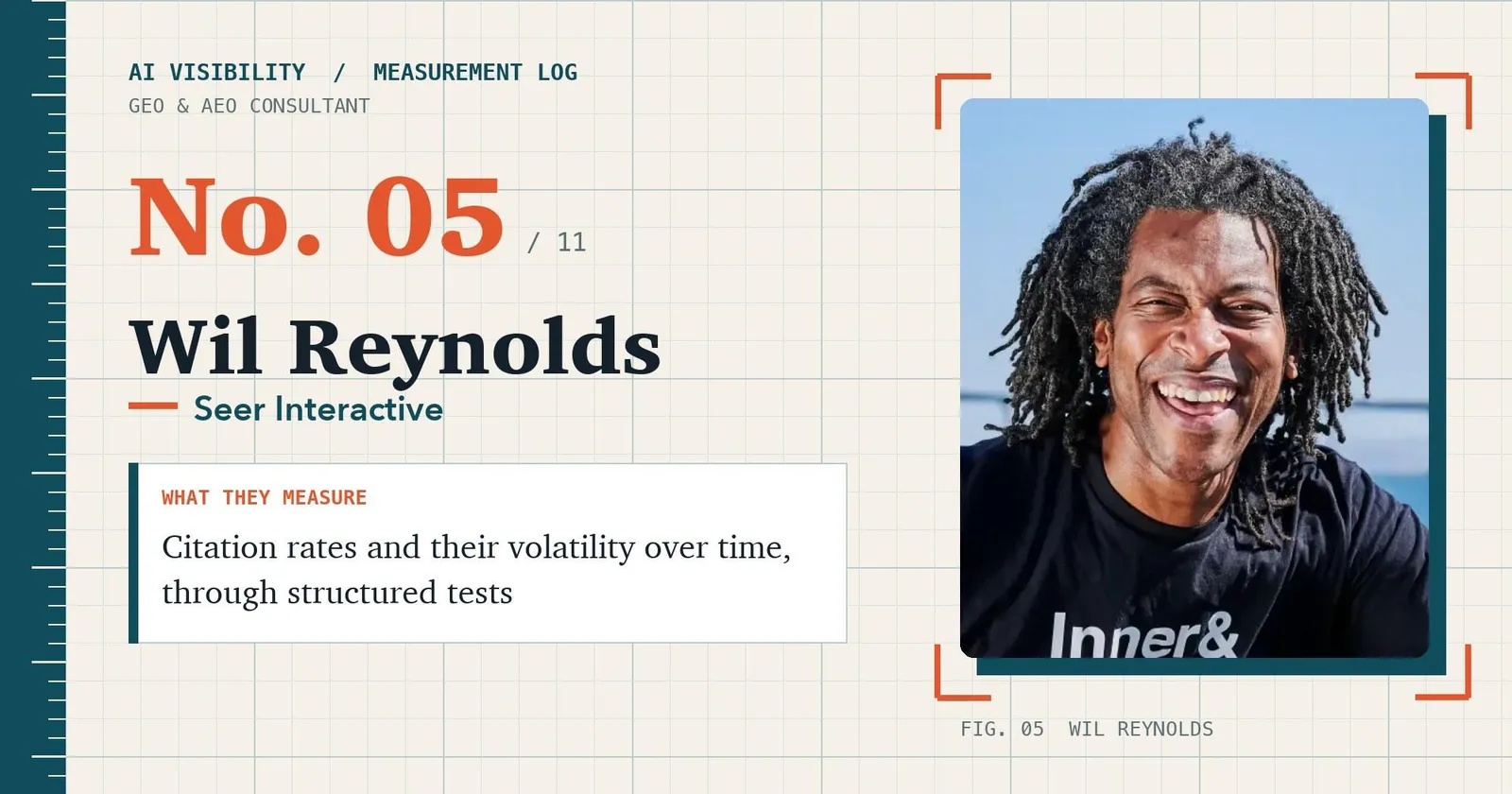
What Wil measures: citation rates and their volatility over time, through structured tests rather than one-off checks.
Wil Reynolds is founder and CEO of Seer Interactive, a Philadelphia agency that reports more than 130 enterprise clients and 92% retention. Seer’s GEO service is built around testing: a prompt development and tracking plan, AI citation and source analysis, model comparison, AI log file analysis and a test prioritization matrix.
The measurement work is public. SeerSonar tracks 625 fixed buyer prompts in ChatGPT about every three days and reports a volatility score and citation rate, a good reminder that AI answers move a lot even when your site does not. Seer’s team also studied 804,491 AI responses and found that brands with even a minimal Trustpilot profile had a median citation rate of 53.5%, against 1% for brands without one. That finding is a correlation, but a useful one for planning off-site work.
- Proof you can check: SeerSonar, the review-profile study and an analysis of ChatGPT query fan-outs across 617 prompts that Wil co-wrote.
- How to work with Seer: you can start with a diagnostic phase, and the firm says you do not need to commit to a 12-month program. No published prices.
- Best fit: enterprise brands that want each recommendation backed by a test. Look elsewhere if: you are an early-stage startup.
Wil Reynolds on LinkedIn | Seer Interactive
6. Lily Ray, Algorythmic: best when AI citations fall with organic traffic
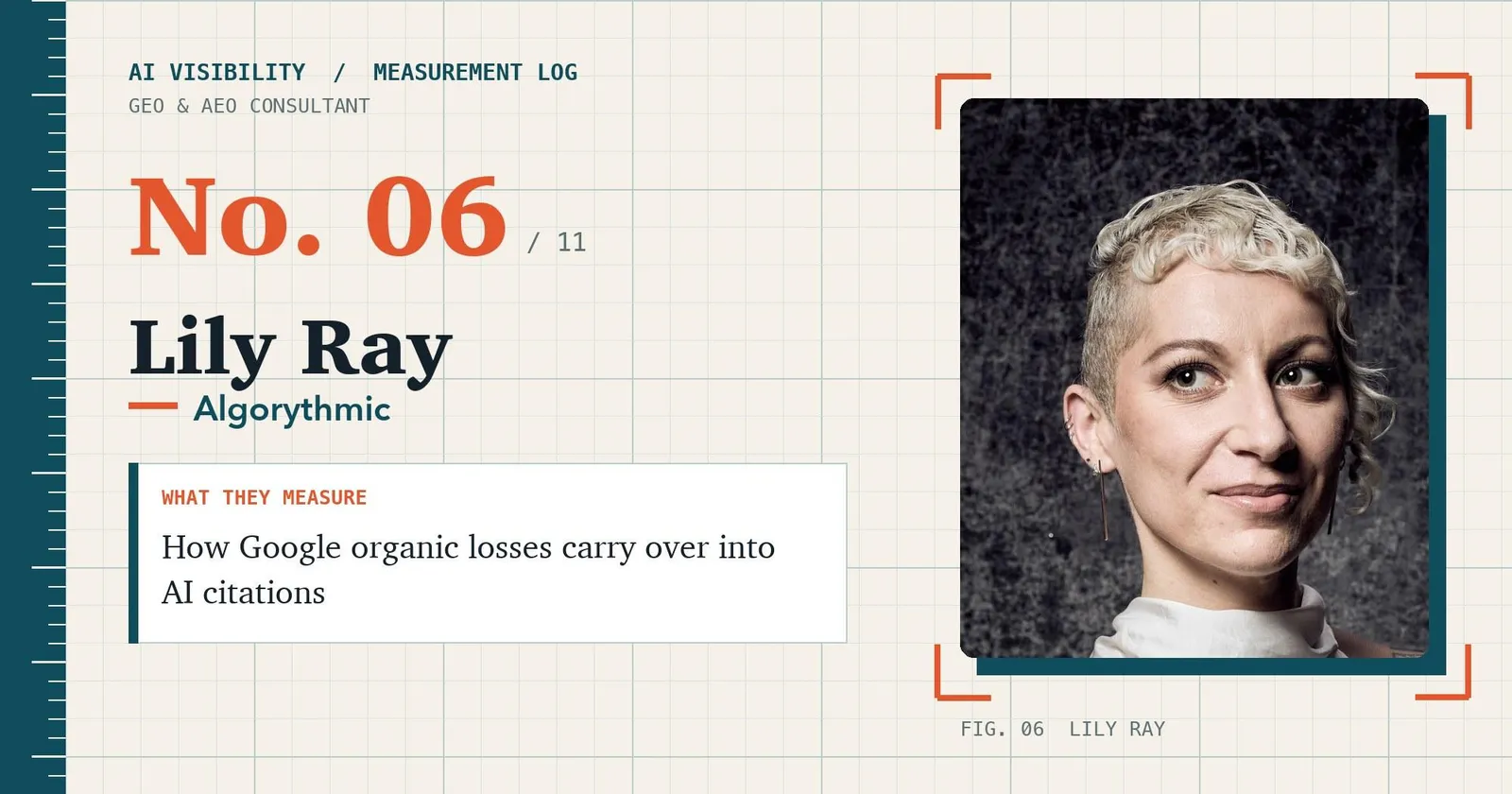
What Lily measures: how organic losses in Google carry over into AI citations, and which content tactics backfire.
Lily Ray is founder of Algorythmic and continues as VP of SEO and AI Search at Amsive in an advisory role. Algorythmic sells SEO and AI search audits, algorithm update recovery, consulting and training, while larger AEO programs go through Amsive.
Lily’s research connects the two worlds. In one analysis of 11 site sections that lost Google visibility, every one of them also lost AI citations: organic traffic fell 26.7% on average, ChatGPT citations 27.8% and AI Mode citations 23.8%, while Perplexity barely moved. A second study of 100 B2B “best software” queries found 323 self-promotional listicles among the cited sources, yet in 69% of cases the brand that published the list was left out of the recommendation.
- Proof you can check: both studies on Lily’s Substack and Search Engine Journal, and the LLM Content Visibility Scanner on Algorythmic, which shows what GPTBot or ClaudeBot can read in your raw HTML.
- How to work with Algorythmic: one-time audits, hourly or ongoing consulting and workshops. No published prices.
- Best fit: content-heavy sites recovering from a Google update. Look elsewhere if: you want a full done-for-you team from one firm.
Lily Ray on LinkedIn | Algorythmic
7. Dan Petrovic, DEJAN: best for model-level analysis of why AI picks a source
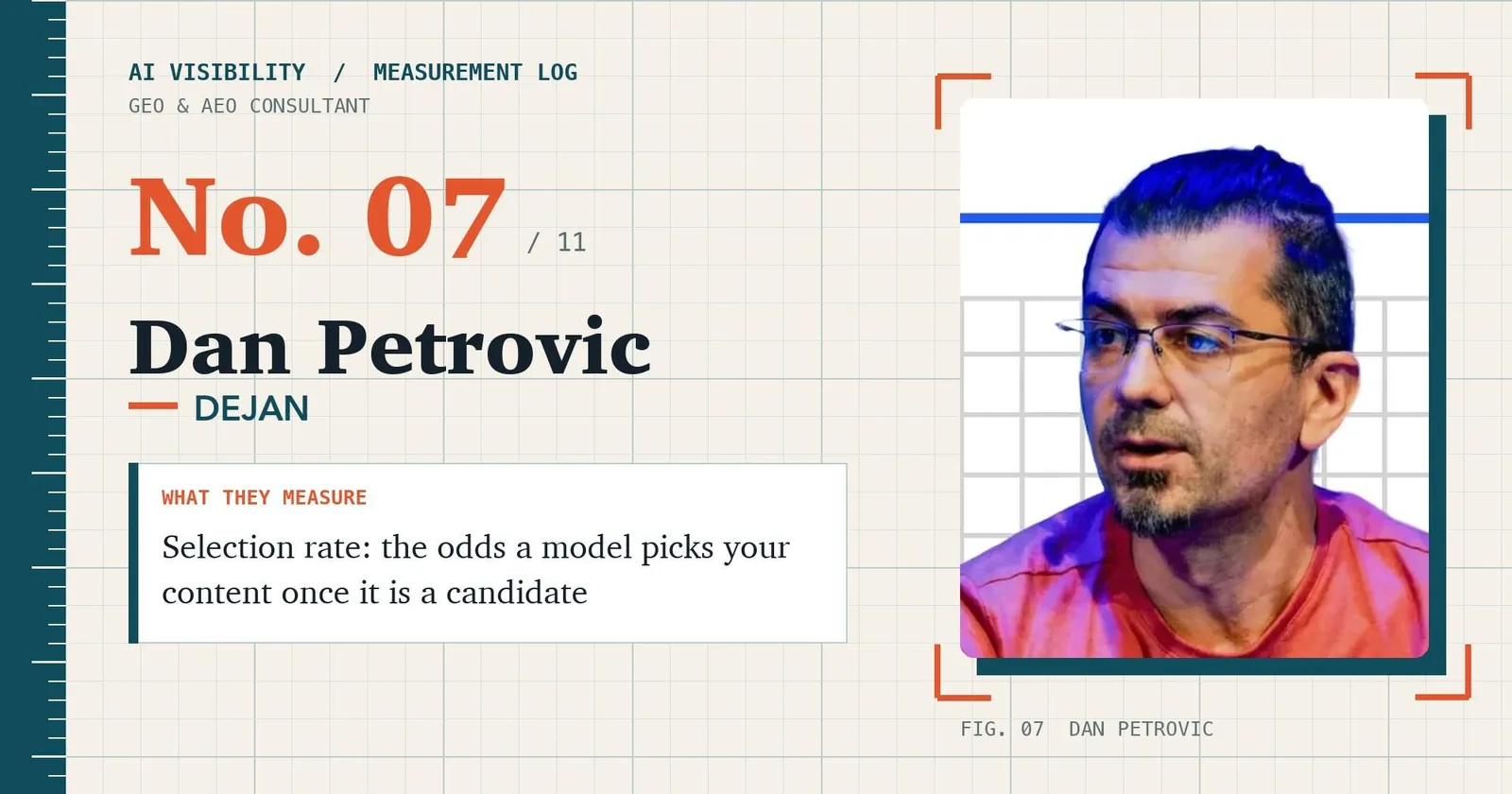
What Dan measures: selection rate, the probability that a model picks your content once it is already among the candidates.
Dan Petrovic leads DEJAN, an AI SEO agency in Brisbane, Australia, with team members across several Australian cities. DEJAN treats selection rate as the AI version of click-through rate, and keeps a content change only if the selection rate goes up.
The research is detailed. In a study of 7,060 queries and 883,262 snippets, DEJAN found that Google gives each query a grounding budget of roughly 2,000 words, and the top-ranked source receives a median of 531 words of it, about 28%. The team also runs AI Flux, which tracks daily volatility in the top ten brand positions inside AI answers, and Tree Walker, which shows the token probabilities behind what a model believes a business sells.
- Proof you can check: the grounding study on DEJAN’s blog and more than 20 tools listed on the DEJAN tools page.
- How to work with DEJAN: a strategic AI search audit for AUD 5,000 plus GST, and retainers from AUD 5,000 a month plus GST.
- Best fit: brands that want data science, not checklists. Look elsewhere if: you need a simple monthly report.
Dan Petrovic on LinkedIn | DEJAN
8. Metehan Yesilyurt: best for reverse-engineering how engines pick sources
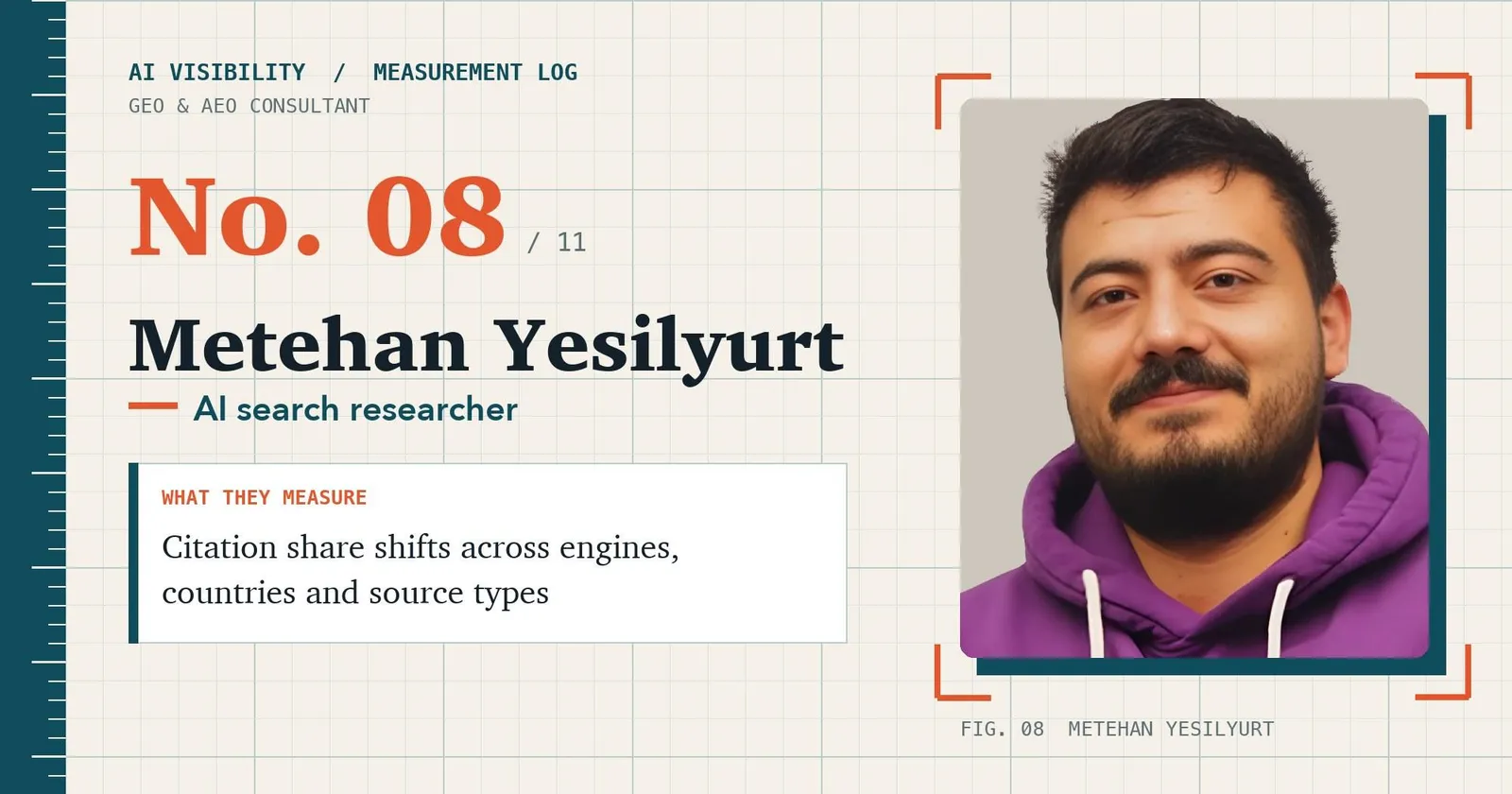
What Metehan measures: shifts in citation share across engines, countries and source types, often at a scale of millions of citations.
Metehan Yesilyurt is an AI search and SEO researcher who works at Peec AI, an AI visibility tracking platform, and takes on consulting projects in AI search optimization, technical audits and content strategy for AI citations. Much of the research uses that platform’s data, so expect advice grounded in tracking tools.
Two recent findings show the style. An analysis of 64.77 million Reddit citations across 20 countries and four engines found that ChatGPT’s share of Reddit citations pointing to machine-translated pages fell from 6.14% to 0.66% within one month. Another tracked Reddit’s share of ChatGPT citations falling from 4.6% to 0.23% in a few weeks. Metehan has also argued for choosing tracked prompts from Search Console data instead of guessing them, and built a tool for it.
- Proof you can check: more than 70 research posts on metehan.ai and talks at BrightonSEO and SEO Week.
- How to work with Metehan: project consulting; the consultancy page explains how to get in touch. No published prices.
- Best fit: teams that want to understand engine behavior in depth. Look elsewhere if: you need an agency to ship changes for you.
Metehan Yesilyurt on LinkedIn | metehan.ai
9. Lazarina Stoy, MLforSEO: best for teams that want to build their own tracking
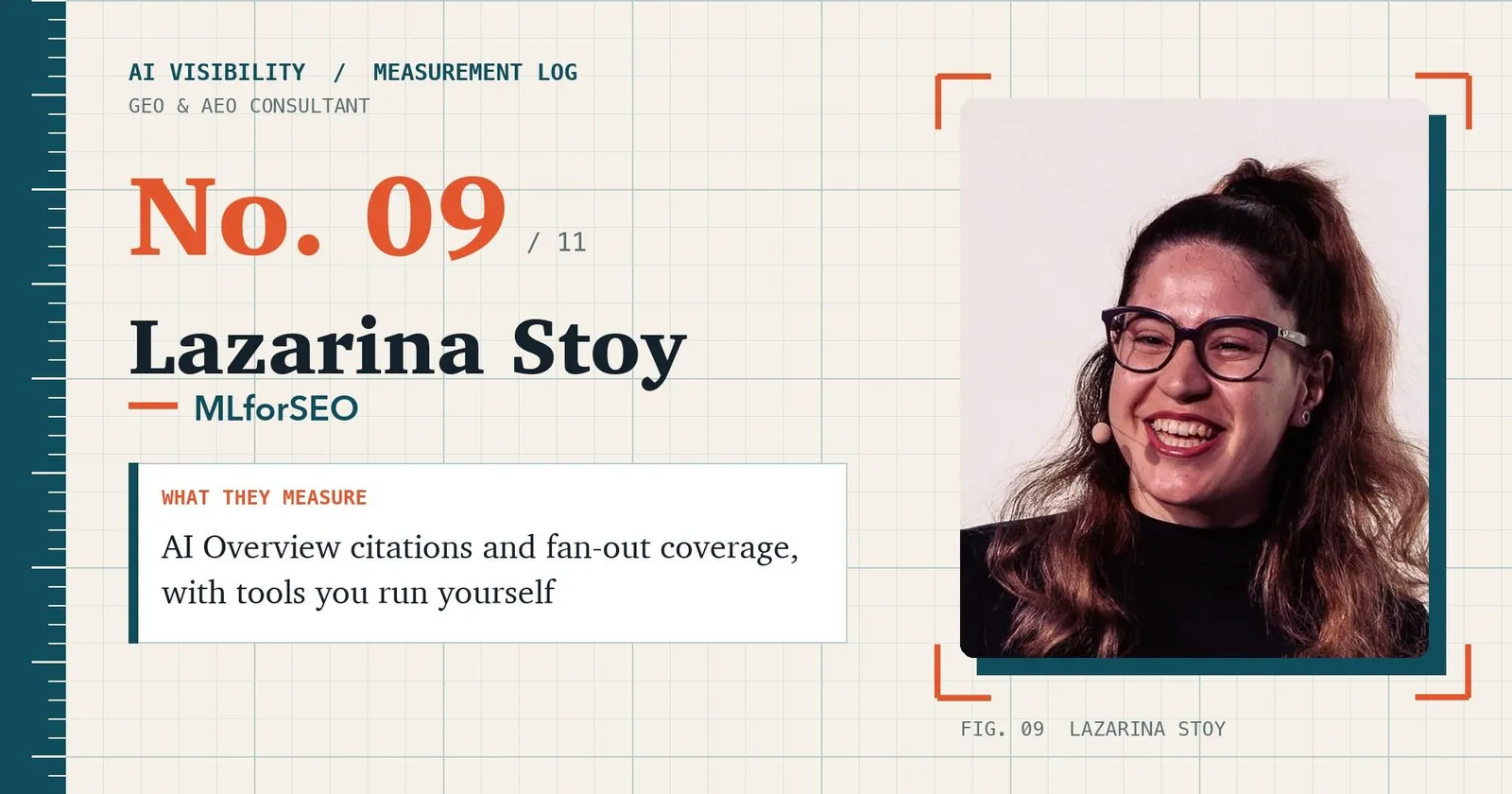
What Lazarina measures: AI Overview presence, cited domains and fan-out coverage, with tools a small team can run itself.
Lazarina Stoy is the founder of MLforSEO and works as a fractional growth and AI automation lead, with search and AI search visibility audits as part of the offer. What makes the work distinct is that the measurement tools are published for anyone to use.
The free AI Overview tracker, a Colab notebook built on a SERP API, records whether an AI Overview appears, which domains it cites and in what order, and where you have gaps, for about $0.40 per 100 keywords. In a sample run, the median overlap between cited URLs and top-ranking URLs was just 22%, which is a good reason not to assume rankings equal citations. Lazarina’s advice is practical: track 50 to 200 fixed keywords weekly and act only on changes that hold for three weeks in a row. A companion Query Fan-Out Coverage Checker labels each passage on your page as covered, partial or a gap.
- Proof you can check: both tools and a 44-point GEO checklist on MLforSEO.
- How to work with Lazarina: a Power Hour for €275, fractional engagements from €2,500 a month and team training from €1,500 a day.
- Best fit: data-minded SEO teams on a budget. Look elsewhere if: you want someone else to do all the work.
Lazarina Stoy on LinkedIn | Lazarina Stoy
10. Olaf Kopp, Aufgesang: best for European brands that want LLM-readable content
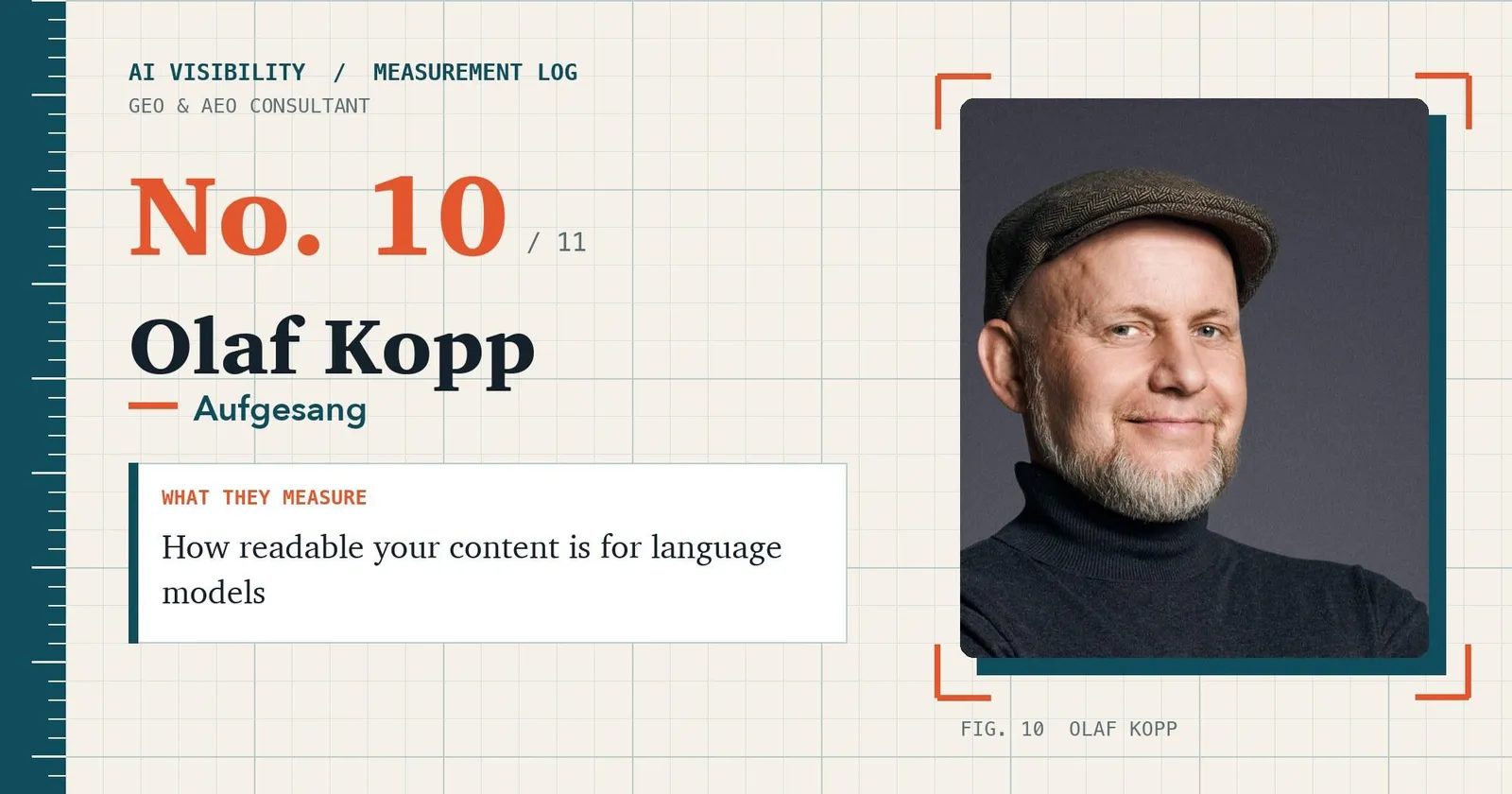
What Olaf measures: how readable your content is for language models, and how often your brand appears next to the attributes you want to own.
Olaf Kopp is co-founder of Aufgesang, an agency in Hannover, Germany, where Olaf heads SEO and GEO. The agency’s digital authority management service covers LLM readability optimization, brand context optimization and a strategy audit.
The measurement starts with content. Aufgesang’s free LLM Readability Check scores up to two URLs from 0 to 100 across eight areas and more than 20 criteria, a method Olaf developed. Beyond the page, Olaf tracks a short KPI set: brand mentions in AI answers, referral traffic from AI platforms, click-through rate, and brand-context match, meaning how often your brand shows up together with the qualities you want to be known for.
- Proof you can check: the readability check, and a long archive of articles on generative AI and search on Olaf’s own site.
- How to work with Aufgesang: a minimum budget of €1,000 a month, with at least six months recommended, after a free 30-minute first call.
- Best fit: German-speaking and European brands. Look elsewhere if: you only need a one-off report.
Olaf Kopp on LinkedIn | Aufgesang
11. Myriam Jessier: best for multilingual brands and teams that want training
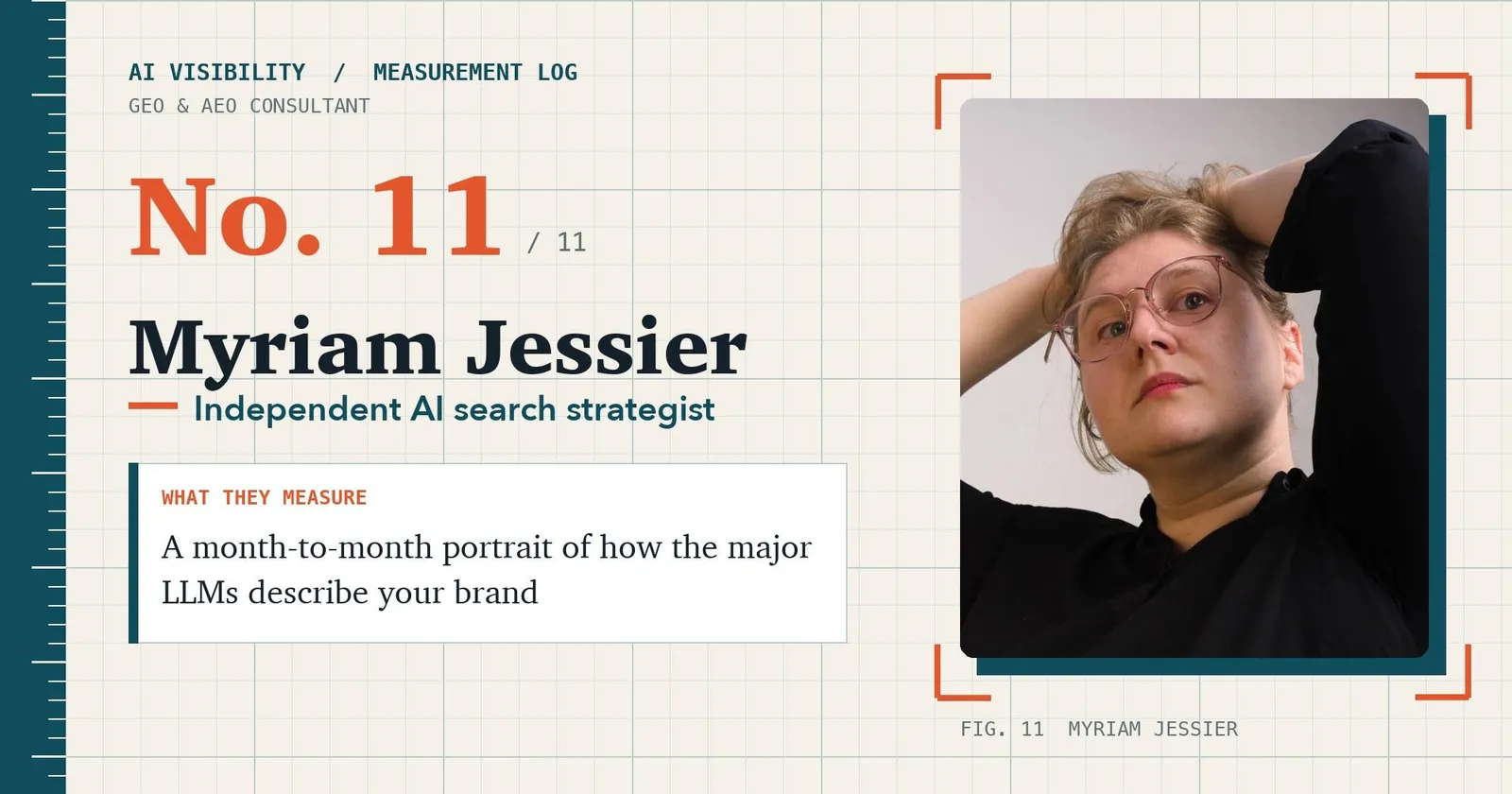
What Myriam measures: a month-to-month portrait of how the major LLMs describe your brand, built on a prompt-tracking framework.
Myriam Jessier is an independent AI search strategist, a monthly columnist for Search Engine Land and a trainer for BrightonSEO’s beginners GEO course. Myriam also co-founded the agency Pragm and now advises it on GEO, where reporting covers ChatGPT, Gemini, Copilot, Perplexity and Claude.
Myriam’s measurement model splits AI visibility into two speeds. Retrievability (structured data, crawl access) can show basic AI visibility in about four to eight weeks. Repositioning, meaning changing what a model believes about you by default, is slower and compounds over time. Separating the two keeps expectations honest and stops teams from judging long-term work by short-term numbers.
- Proof you can check: the published rate card, the Search Engine Land column, and workshop topics such as prompt tracking.
- How to work with Myriam: audits and advisory priced on request, plus workshops from €750 for a 90-minute remote session.
- Best fit: international brands working in English and French, and teams that want to learn to do it themselves. Look elsewhere if: you want a large done-for-you team.
Myriam Jessier on LinkedIn | Myriam Jessier
Run your own baseline before the first call
An hour of work before you talk to anyone will make every proposal easier to judge.
- Write 15 to 20 buyer prompts. Use the words buyers use before they know your name, such as “best expense software for a 50-person startup.”
- Run each prompt several times in each engine. Answers vary between runs, so one screenshot is not a baseline. Note who is named, in what order, and which sites are cited.
- Ask AI about your brand by name. Write down anything wrong about pricing, features or category.
- Check crawler access. Make sure your robots.txt and firewall do not block the AI crawlers you want reading your site.
- Save it all in one sheet with today’s date. That sheet is what every consultant’s report should improve on.
Then ask each candidate to explain, using your own sheet, what they would track and why. ContextBolt’s list of questions to ask before hiring an SEO agency works just as well for GEO and AEO proposals.
Questions that expose a weak measurement plan
- “How many times do you run each prompt?” One run per prompt is noise. Look for repeated runs or rolling averages.
- “Which engines do you track, and why those?” The answer should match where your buyers actually ask.
- “How do you tie AI visibility to leads?” Expect a mix of AI referral traffic, self-reported attribution and CRM data.
- “What would make you change the plan?” Good consultants name the signal that tells them a tactic is not working.
- “Can I see a real report?” Anonymized is fine. A report with no actual AI answers in it is a warning sign.
What GEO and AEO consultants cost
Published prices on this list range from a €275 Power Hour to retainers in the thousands per month. Arobis AI audits start at $399 with programs from $2,500 a month, Lazarina Stoy’s fractional work starts at €2,500 a month, Aufgesang sets a €1,000 monthly minimum, and DEJAN charges AUD 5,000 for an audit and from AUD 5,000 a month for a retainer. Most others quote after a first call. Whatever you pay, budget for at least two to three months before judging results, since changes that depend on third-party sources and model updates take time to show.
The bottom line
Choose the consultant whose scoreboard matches your goal. If you sell B2B software and want to be on the shortlist when buyers ask AI which vendor to pick, start with Ran Yosef. If you need enterprise-grade tracking, research-led strategy, recovery work, model-level analysis or tools your own team can run, the other ten each measure something different, and now you know exactly what.