DataForSEO prices its MCP server differently from Ahrefs and Semrush. There’s no plan to pick, no seat to buy, and no monthly fee. You fund a balance with a $50 minimum payment, and each call draws it down.
If you’re weighing it against a subscription, the question is whether metered billing suits how you work, and the answer depends on your volume and how much wiring you’ll tolerate.
- No subscription and no MCP fee. You pay only for the calls you make.
- $50 is the minimum payment to fund an account. There is a free trial to test first.
- Per-request costs vary by API and are published per product, not as one headline number.
- Your time is the hidden cost: you are wiring raw API access, not buying a finished tool. ContextBolt SEO is the finished version on the same underlying data, $35 a month with nothing to wire, AI-visibility tools included and an SEO Dashboard that keeps every lookup.
How does DataForSEO pay as you go work?
Ahrefs and Semrush sell you a seat and let the MCP read it. DataForSEO sells you data by the request, and that changes who it suits.
- Nothing expires monthly. A funded balance sits there. If you do no SEO in September, September costs you nothing. On a subscription, a quiet month costs the same as a busy one.
- Your bill scales with use, in both directions. Ten lookups is nearly free. Ten thousand is a real invoice. There’s no plan ceiling protecting you from a runaway agent, and no unused allowance going to waste either.
- You can’t know your monthly cost in advance. With a metered plan you know you’ll spend $35 or $129. Here you find out afterwards, which is fine for a business and uncomfortable for a solo builder watching every outgoing.
The $50 minimum payment is the one fixed number. It’s what it takes to fund an account and make calls beyond the trial.
Head to head ContextBolt SEO vs Semrush MCP Prefer a seat to a balance? What a new account pays to reach Semrush MCP, set against our flat $35 a month. Read the comparisonWhat does DataForSEO MCP give you access to?
The current v3 MCP server has four tools. Three browse the DataForSEO documentation and one makes an authenticated request to any endpoint, so your agent reads the docs and builds the call itself. That reaches the whole API, including these families:
- SERP API: live Google, Bing and Yahoo results for any location and language
- Keyword Data API: volumes, CPC and related keyword data
- DataForSEO Labs API: keyword research and market analysis datasets
- Backlinks API: backlink and referring domain data from their index
- On-Page API: technical crawl and page-level audit data
- Domain Analytics API: technologies and Whois records for any site
- Business Data API: reviews, business listings and social data
- AI Optimization API: LLM prompt data and aggregated AI assistant answers
The last one gets more useful each month. Tracking whether AI assistants mention your brand is becoming its own discipline, and having it behind the same API puts DataForSEO ahead of most suites.
What does it cost besides the per-call price?
Per-request prices are published per API rather than as one figure, so for exact numbers read the product pricing page for the specific API you plan to use heavily. A SERP call and a full backlink report are not remotely the same cost.
The second cost is the one that usually decides it. You’re buying wholesale data, not a product, so you handle credentials and the raw JSON, and a raw API response isn’t an answer. When an agent pulls back an unshaped payload, it either dumps a wall of numbers into your chat or misreads a field. Someone has to turn the data into something a human can act on, and in this model that’s you.
The third cost shows up a month in. Ask your agent about a keyword today and the answer lives in that chat. Close it and the research goes with it. DataForSEO does have a dashboard, but it’s a billing console: your balance, spend per endpoint, credentials, invoices and the error codes from failed tasks. None of it is a record of what you found. So the second time you need that keyword, you scroll back through old chats or pay for the lookup again.
For a developer building a tool on top, that’s exactly right and DataForSEO is the correct choice. Many SEO products are built on it for that reason. For someone who just wants to ask Claude whether a keyword is winnable, it’s a weekend of plumbing to save a few dollars a month.
Is DataForSEO MCP right for you?
- You are building a product or internal tool on top of the data.
- Your volume is spiky, so a subscription would sit idle half the year.
- You want the whole API behind one server, including AI answer data.
- You are comfortable with credentials, raw responses and reading per-API pricing.
- You want a predictable monthly number for budgeting.
- You want digested answers rather than raw JSON in your agent.
- You do not want to fund and monitor a prepaid balance.
- Setup time is worth more to you than the per-call saving.
- You want your past research to live somewhere you can go back and read.
If you decide it’s for you, the step-by-step is in the DataForSEO MCP setup guide.
Where does ContextBolt SEO fit?
ContextBolt SEO is our product, and it runs on DataForSEO data. The wholesale layer is the same one this article is about. What differs is everything built on top of it.
For $35 a month and 1,000 credits, after a 7-day free trial, you get one URL to paste into Claude, Cursor, Codex or ChatGPT, with no account provisioning and no balance to fund. Every tool returns a digested answer with a verdict line rather than a payload. Research tools cost one credit, backlink tools cost three, and Google Search Console tools are free and never touch your credits.
Every lookup also writes itself down. It lands on your SEO Dashboard, a private page where every keyword, domain and audit you’ve run sits as a card you can open. You never set it up, because using the tools fills it. Asking about the same keyword next month leads with what changed, and last quarter’s research is still there when you sign in.
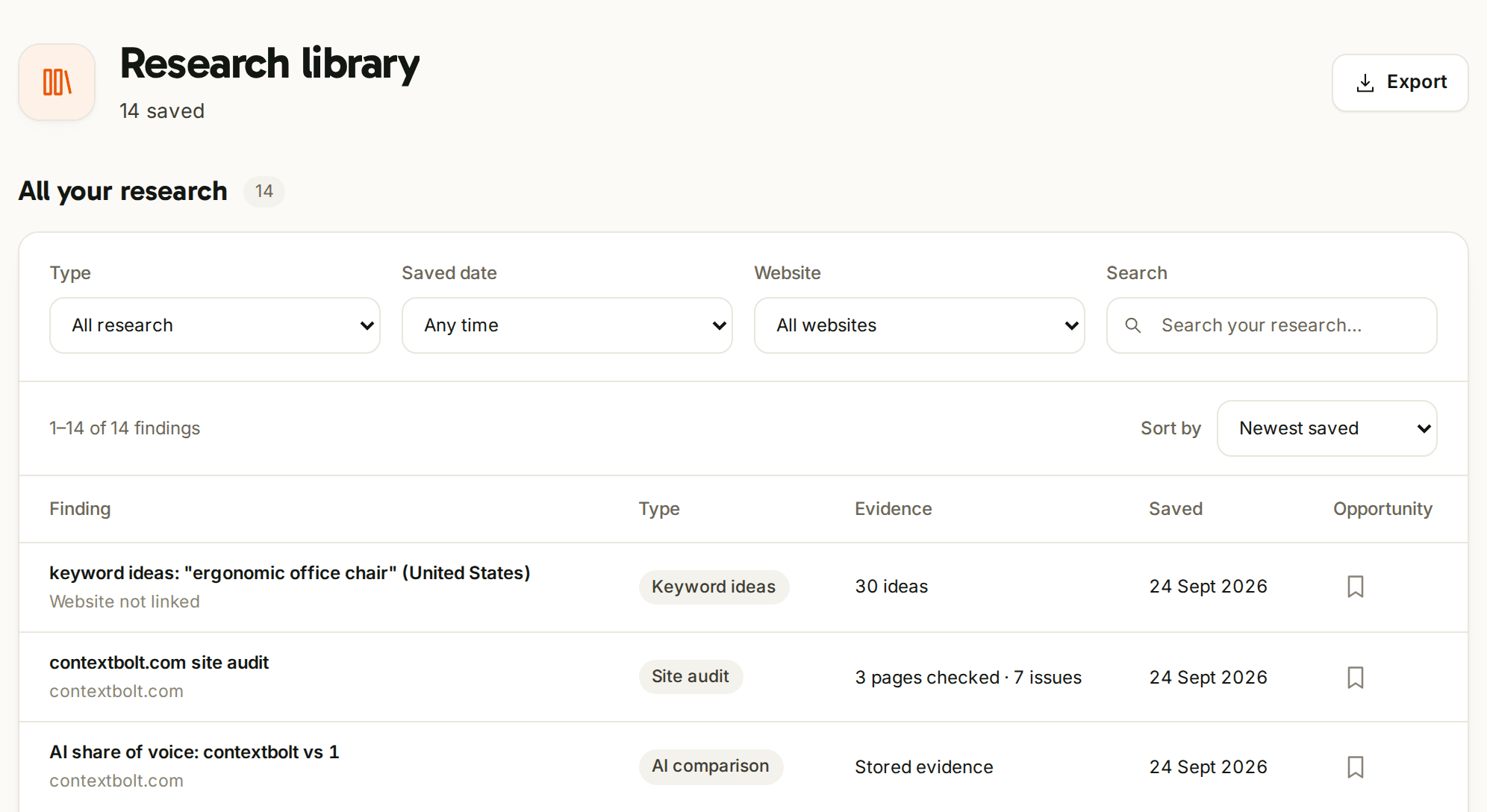
The SEO Dashboard keeps each lookup with its date, so the research outlasts the chat.
You’re paying for packaging, predictability and the digest, not for data nobody else can get. If you’re building a product on the raw API and handling the responses yourself, DataForSEO direct is the right tool and the per-call price will be lower than a flat plan. If you want the answer in your agent and the record on an SEO Dashboard, with nothing to wire, the free trial is seven days. The line-by-line comparison lays out both sides.
Head to head ContextBolt SEO vs DataForSEO MCP Both sides set out: what sits on top of the shared data, what each really costs, and where the raw API still wins. Read the comparison